The Being of Joe

By Donald Felipe

2016

Prologue

Months and years pass. Our routines seem to have lives of their own, a drive and lunch at a familiar place, comments I have heard on countless occasions, and requests I anticipate well before I hear them. Trees, birds, blue skies, and mountains green, all before, with him on another Sunday, have been seen, now seen once more.

When I started writing about my brother I wanted to present him to an audience. I wanted to step out of the way so that an audience could gaze upon his miraculous life. And I was foolish to think that possible; there will forever be something of me in what I say about him. I am forever a part of him, and he, me. It is not his presence, but our presence, that yearns to be. And that presence, rising to the surface of our being, is love.

But the presence and being of my brother is not contained in anything said or done. His presence is more than what I can see and think. There are others present with him and in him, including myself. The metaphor of fabric brings to the surface what I cannot explain. Beings woven together with threads of Love, threads that cannot be contained in one garment. Love is the thread and the life that flows through it; like veins of his being flowing in prayerful living, in every thought and intention. In his eyes, loss is overcome, fear is overcome, suffering brushes by unnamed, and death itself holds no obstacles. And that presence passes to me. From me and from all those it touches, in a breath of hope, it seeks others. 

The threads, the blood, the flesh, Being, Love, Spirit, mysterious metaphors for what the Church calls the Trinity, but not the Trinity by itself, an abstract idea, an incomprehensible mystery. The Trinity in us, a presence of which we are part, alive, a presence with a purpose, to heal, to reconcile, to teach, to love, to make joyful. 

In the space I occupy in this life I cannot see and live like my brother. But his being, and the Being that embraces him, pass to me in little ways, in routines that play out like songs heard a thousand times, casting a light on all that is between us, and is a part of me.

I used to sing as a child, in a choir at the age of eight or so. I find myself singing again these days. And I know the being of my brother, who lives among the voiceless, the dying, sings with me.

The Present

“Joe and I are well.” A cursory telling of the present might be like this—the kind of telling that says, “That is all I want to say, and that is a good thing”. Retorts like this are irresistible, at times, when smothered in the dull sameness of life.  

“Life goes on,” I might say. “Sufferings and joys are within limits.”

And this might be the best of news for those suffering from dementia or Alzheimer’s, or a great consolation for those who care for them.

My brother does not suffer from these afflictions, as his housemates do, and I am only with him for a few hours a week. Being with my brother is a great blessing in my life. Yet here I am. And part of me wants to tell the present like this.

The love I share from being with my brother cannot annihilate this shallow malaise.

“You’ve got to have a prayer life, Donnie,” Joe says.

Opening the door
In the lobby
On lounge chairs
Holy souls are gathered.

Eyes closed.
Heads down.
Sleeping.
Waiting.

Briskly, I walk by
A little love in every step
Smile and wave.

But my eyes betray my love
I don’t want to look.

In the hallway
Clean floor
Smell of feces.
A man sliding his feet
Pajamas and slippers
Inching forward
With all his strength.

Rounding the corner
The door is open.
“Hey Joe!” I say.

Sitting on the bed,
Hands on knees
Gleefully smiling.

“Well, hey partner!”

Always something to say to me,
While holy souls are sleeping
Waiting.
You are,
One and the same,
Always the same,
Always. 

An Afternoon

Electronic cigarettes,  two singles for your weekly treat. Don’t forget a twelve pack of soda, and some canned goods. You should have enough instant coffee, but you drink coffee like water, only decaf for you. Costs more. If there is time, we go to Cozy Diner in Paradise. There is not a single entry on the menu less than one thousand calories. I know it is your day off, but I am getting fat. And then, we take our drive. A jaunt up the road through the trees.

You gaze at the trees and laugh loudly.

“See Donnie, they are all the same height!”

“They are all the same height! They are all the same height!”

“Ha! Ha! Ha!”

The Bells

Riding my bike in the park I saw a little girl in the distance. She was riding a brand new pink bicycle, purple streamers poking from the grips, steadied by training wheels under the watchful eye of her mother.  She smiled at me still at some distance away; a big, puffy, heart-shaped pillow etched in lace centered on the handlebars, leading the way like a headlight. As she passed by me she again smiled not saying a word,

“Ring, ring,” chimed the bell.

 She continued on moving slowly, teetering from side to side along the bike path. Her mother beside her, ever-present.

I passed by and rode off in the other direction, but I could not forget her. 

“Ring, ring.”

Donuts

On some days Joe wants donuts. He seems to want specific kinds, but in the end he eats whatever there is. Chocolate, glazed, powdered, fritters, apple or blueberry, bear claws, he eats them all with abandonment, as if it were his final meal. 

“I love everything God’s got,” he says.

The Hawk

We emerged from the parking lot through the blue, iron gate, and as we drove by a retirement complex across the street, I saw something. I could not believe my eyes; a majestic red tail hawk was resting on the lawn in plain view in the middle of the suburbs. It just sat there.

I point out the window,

“Look at that hawk Joe! He thinks he is a pigeon.”

The Premature Burial

An interruption to our happy rituals came suddenly last October, as all such interruptions do. It began with some news from my dear wife, who had also been visiting Joe—something about Joe’s leg. He was scratching it. My wife looked into it, and then I eventually got involved. Slowly the gravity of the problem sunk in. Joe needed to see a doctor.

Then, one rainy morning I took Joe to the Wound Clinic, and I got a glimpse of the trouble: ulcers and sores had opened all along Joe’s bad leg, from the ankle to the knee, right along the shin bone. This was no mere problem of dry skin and ‘picking scabs’; there was something internally wrong with Joe’s leg, crushed seventeen years ago.

The doctor caring for Joe was absolutely delightful, the sort of caregiver patients pray for. He joked with Joe and me, while meticulously examining the wound and explaining treatment.  “Swelling is the cause,” he said.  Internal injuries cause swelling. Swelling causes itching. Itching causes cuts and more swelling, and more serious wounds in a cycle. Eliminate infection. Treat and heal the wounds. Then, take steps to mitigate the swelling. 

We had a plan.

In the months that followed, my wife and I took Joe to the Wound Clinic once a week to get his wounds cleaned and his bandages changed. After the Clinic, I took Joe out to lunch, and we talk as we always talk, drive as we always drive, laugh as we always laugh. 

In the past weeks Joe’s leg got a little better, then a little worse. Then it got very much better, then a little worse. Now, after five months or so, it appears that the internal swelling will not allow the leg to completely heal. Life goes on. Suffering and joys are within limits.

But my brother will not allow limits. Love will not allow it. Boundaries must be crossed. Time itself must be overcome.

And so it is that one day, on a weekly visit to the doctor, Love peeked through a fold in time.

On that day Joe was in a joyous mood from the moment I saw him. As we drove around the bend toward the main street, he up righted himself and pointing straight ahead with a look of awe,

“Look at that! Ha! Ha! Ha!” he chuckled in amazement.

At first I did not notice anything–just a bunch of bushes across the street, and then I saw it. The sun had been out the past few days, and one bush had erupted in bright purple blossoms, shining against the backdrop of dozens of leafless, grey bushes and trees. 

Life amongst the dead, I thought, or is it life among the soon to be alive.

Our light-heartedness carried on at the doctor’s office—it was one of those days. My wife joined us. The doctor himself was riding happy waves; and when the bandage was removed, I felt like yet another miracle had occurred; Joe’s once ulcer-ridden leg was almost completely healed.

“Alright Joe!” I exclaimed. Joe grinned with satisfaction under the brim of his little black cowboy hat. 

“You’ve got new skin here cowboy,” the doctor said. “There is just one more place here,” he said, pointing to one last open wound. “That should heal up by next week.” 

With all worry about Joe’s leg put to rest I struck up a conversation with the doctor. I don’t remember what we talked about—fanciful small talk.

Then, Joe interjected himself speaking in a loud voice, entirely uncharacteristic of him, as if he wanted to completely change the conversation.

“You know Edgar Allen Poe. There is a movie about this story. A man is buried alive. And then he gets up out of his coffin and runs away! Ha! Ha! Ha! Ha!” Joe’s broke out in infectious laughter.

I laughed along with him, but I did not know why. Where did that come from?

The doctor and nurse seemed a little confused, but our laughter, and the joy in the room brought them to smiles as well. Then after a few seconds, the doctor broke into an Edgar-Allen-Poe inspired story of his own.

“You know, when I was in residency I worked in this big hospital with a few hundred patients. And at night people would die. People were always dying,” he said as light-heartedly as he could. “And I would get called in to pronounce people dead. So, I would check their vital signs and do what I was supposed to do. And then I pronounced them ‘dead’. But at night I would dream that they would come back to life in the morgue.”

 “Yeah, I remember my friend got called to do the same thing one night. He was a new resident. His first time, and he didn’t know what to do. So, he came in and the family was there waiting. He stood at the end of the bed and raised his arms,” and as he said this he raised his arms like Moses parting the red sea, “and said. ‘I now pronounce you dead’”

As we emerged from that appointment, I felt what I have often felt with my brother—I don’t know how to describe it–something or someone pulling at me, demanding that I do something, a feeling that something has been planted in me, questions that require attention.

I have been listening to Joe’s stories, comments, jokes, delusions, speculations, lessons, advice for around forty years now. I have heard them all. And many of them I have heard hundreds of times, and that is not an exaggeration, and I cannot ever remember any mention of Edgar Allen Poe and the man who ran away from the grave. 

Joe had ruptured the present. And the doctor had unwittingly and enthusiastically aided him; time and space had been torn and shards of love tossed into the air seeking resting places.

After our lunch, our drive, and our return to our lives apart, Edgar Allen Poe remained buried in my mind. And then, in a flash he rose again. What is this story? What is this film? Does it even exist?

****************************

In October of 1962 my brother Joe turned fifteen. I would turn five a month later. We lived in a house in the hills outside Oroville California, with our dear parents, and my little sister Paula, who was then two years old. My memories of that time past are serene, rolling in the tall green grass and flowers, smells of spring, playing in the rich, red dirt, throwing rocks, listening to birds, wandering on trails through bushes and trees, sitting in the dry, yellow grass of summer, basking in the sun. My father had a pile of loam dumped in the yard just for me—and I dug and dug until my clothes and skin were covered. He built a full-size basketball hoop, but it was too big for me. He taught me how to pitch a baseball before my little hands could even handle one—so, I used rocks instead. 

“Bang!” A rock strikes a tree.

I did not know suffering as a child, except normal pains that come with earaches, fevers, coughs and such. Well-loved by my mother and father, growing up in the countryside, the kind of childhood parents dream out of love for their children.
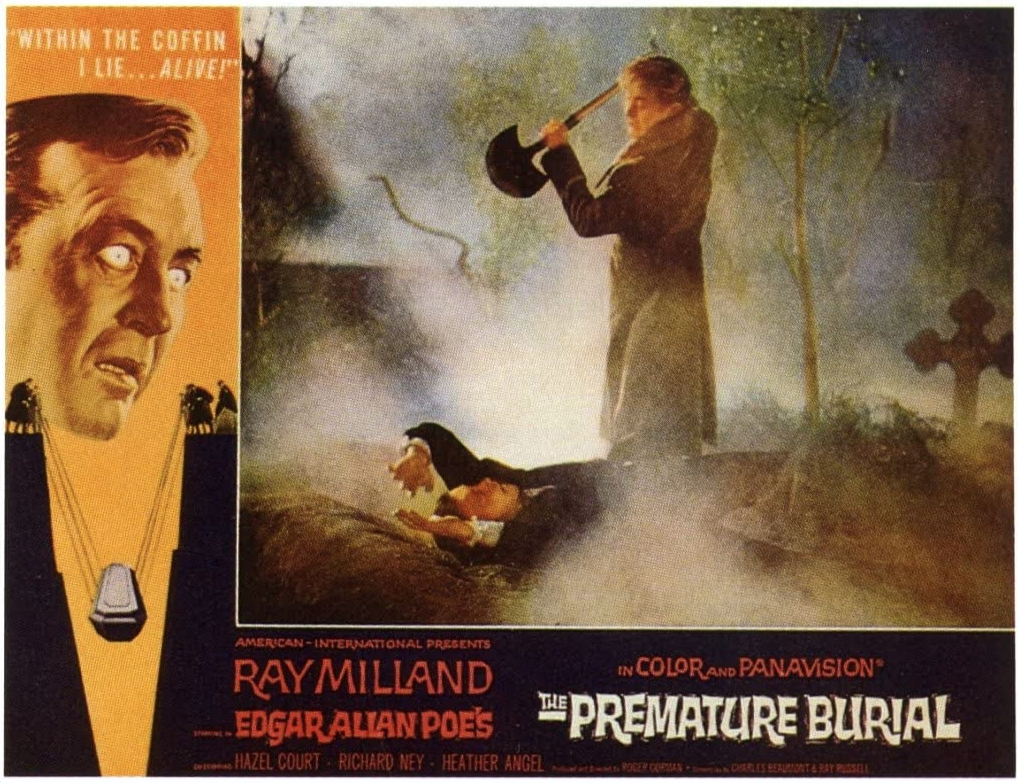
My brother had drawn me from the present to the past, to 1962, the year that the film Premature Burial was released. The film was the third in a series of eight horror films directed by Roger Corman based on the stories of Edgar Allan Poe, including The House of Usher, The Pit and the Pendulum and the Raven. These were classic films that influenced the whole genre of horror to follow— Premature Burial is among the early influences on the cult classic Dawn of the Dead, released in 1968, the beginning of the zombie genre that flourishes in the present as never before—part of a global fascination with death, corpses, gore, atrocity, gruesome spectacles, apocalypse and dystopian futures of all kinds.

“Ha! Ha! Ha! Ha!” Joe laughed seeing the man run away from his grave.

 
The film departs in many respects from Poe’s short story, but neither the film nor the text is at all light-hearted. The main character of the film, like the narrator of Poe’s story, suffers from an obsessive fear of being buried alive. He hears voices and whistling and has visions of gravediggers that no one else can hear or see. He claims to suffer from catalepsy, an illness producing the appearance of being dead, while being alive. He builds a tomb that will allow him various means of escape, which he later destroys upon the insistence of his scheming wife.


The main character attempts to overcome his fear by opening the tomb of his dead father, who, he believes, was interred alive. The corpse of his father falls on him and he appears to die of a heart attack. He awakens in his coffin as he is being carried to his grave, unable to speak or move. Then, his worst fear is realized, he is buried alive.

Shortly thereafter a doctor orders an exhumation. As the coffin is opened the man leaps out. He kills both gravediggers, who, he believes, conspired to drive him mad. Then he runs off to seek revenge on others. 

Viewing the film and reading the story drew me further into the grounds of the past, and I could not help imaging Joe as he was then–a teenage boy fighting seedling voices sprouting within—voices and figures with their own terrifying personality, part of him.

In his short story Poe personifies the irrational fears that haunt the main character in a dialogue of terror,

“While I remained motionless, and busied in endeavors to collect my thought, the cold hand grasped me fiercely by the wrist, shaking it petulantly, while the gibbering voice said again:

“Arise! did I not bid thee arise?”

“And who,” I demanded, “art thou?”

“I have no name in the regions which I inhabit,” replied the voice, mournfully; “I was mortal, but am fiend. I was merciless, but am pitiful. Thou dost feel that I shudder. — My teeth chatter as I speak, yet it is not with the chilliness of the night — of the night without end.” But this hideousness is insufferable. How canst thou tranquilly sleep? I cannot rest for the cry of these great agonies. These sights are more than I can bear. Get thee up! Come with me into the outer Night, and let me unfold to thee the graves. Is not this a spectacle of woe? — Behold!”

Poe’s story dragged me back into the past, into the hell that afflicted our family many years ago. My brother’s endless nights of pain, shrieking, blaring music, stench of cigarettes, beer cans, incessant, ominous grumbling, striking each one of us in different ways, draining my mother and father of hope, enveloping my sister in fear, and piercing my mind with the terror that I might be the next son to go mad, the innocence of a well-loved child covered over in pain and fear sinking into the ground, only to rise again.

Return to the Present

That morning, I had received mournful news; a close relative had died. He was such a vibrant, good man, and a dear friend. My cousin, his rambunctious, gregarious wife, whom I loved dearly, had died young as well, around ten years ago now. I grieved again for her, for him, for their daughter, who had sent me the news, for another cousin, for the whole family. I had been praying and praying that he be healed of his leukemia, an unlikely scenario for a man in his late 50s. I had real hope and faith. The brutality of nature, the realities of the present, closed in on me that morning, and the proud philosopher in me woke up; my love inspired faith was foolish and irrational, he said.

I went to a café to distract myself, read, write, and brood. I had just ordered a coffee and was walking to the end of the counter to pick it up. 

A little girl, who was with her father some distance away, scampered toward me for no apparent reason.

“Boo!”, she shouted playfully.

When will I see you again?

“Ha! Ha! Ha! Ha!” Joe laughed as we talked about our springtime plans to barbecue in the park and have a couple of cold beers gibbering in his inaudible happy tones, and I laugh along with him. 

In the cosmic tug of war between love and despair, love always prevails. And as the present moves ever forward, our love gets stronger. It wants to run away, like the man in Joe’s mind jumping out of his coffin. 

But, as I have said before, Joe is always the same, really—although he has become quite accustomed to our weekly outings, which he now calls ‘his days off’. 

“When will I see you again?” he always asks.

 Poe and The Philosopher

Poe continues,

“the rigid embrace of the narrow house — the blackness of the absolute Night — the silence like a sea that overwhelms — the unseen but palpable presence of the Conqueror Worm”

True love resists and grows, spreading, taking root, pulling me toward love in the present and beyond the present, beyond time. 

“Projections!”, the philosopher asserts, “A delusional escape from the terror of nothingness. The end of Being!” 

Poe chimes in,

“Your hope arises from helplessness and fear—weakling, hypocrite, insufferable fool!”

Pride and knowledge are too big to see beyond time. I must be little, trusting and humble. An initiation in the hunt for tears and holes in the fabric of the present, to play, to peek into heaven. Science and knowledge fashion being and tell what there is, and what can be. Love’s delights, the antidotes, the substance unraveling concrete, turning stone into cloth, permeate the visible world. I learn how to find them.

Through the Veil

Purple blossoms against scratchy grey, 

“Ring, ring.”

A donut feast.

“They are all the same height! They are all the same height!”

A hawk who thought he was a pigeon, 

“Boo!”

In these I sense the truth; unbreakable threads, finer than silk, yet invisible, bind me to my brother, and to everyone else, in charity—and I will know that love has taken root in the ways I treat others— a web of love from which there is no escape. Creases and wrinkles in time toss up tiny hopes that only love can see, as mothers and fathers sense in the innocent baby talk of their darlings, crawling on the floor, flapping their arms, running in circles, dance-walking.

Veils on faces of the dying flutter in the wind and tempt the heart to flight; the self-covered to be remade, shattered to be formed anew, vanishing to reappear, dying to be born again, like a fetus in the womb of Love. Revolting smells remain bitter, separation is real and sorrowful, fatigue and malaise as natural as the flowers and trees. But Love reveals the veil, a pliable curtain, and probing its texture for meaning—that loss materialized wants to transform and fly away like a bird redeemed.

As one child healer innocently raises his arms in a spontaneous ritual to pronounce what cannot be said, mimicking the Christ before the tomb of Lazareth, as another good healer dreams of the dead reawaking, on the edge of time, like children drawn to the invisible truth. The good and loving God, I believe, will one day help our minds. In the meantime, my brother is with me, his being is mine also. He is in me and I in him. 

“Bang!” a rock hits the tree, and I am like a child again, in the present blooming with roots pulsing from the ground, drawing on aquifers of suffering and broken heartedness transformed and cleansed in waters of love. 

“Ha! Ha! Ha!” Joe laughs, as he sees the man run away from his grave.

Joe and God have remade the film and rewritten Poe’s story to transform the past into the present and beyond, to transform fear and suffering into laughter and joy–making Joe the man running from death laughing like a child at play into the hands of God. 

The Hope of Joe

By Donald Felipe

(This essay was presented on November 3, 2014, at the 11th Global Conference on Suffering, Dying and Death in Prague, Czech Republic.)

Two weeks before my departure for this conference, as I was driving with Joe at the beginning of our Sunday journey, I told Joe that I would be going on a trip. 

“Where are you going?” he asked.

“Czechoslovakia,” I replied. “To Prague.”

“What are you going to do there?”

“I am going to a conference,” I said with some trepidation. I have yet to tell Joe that I am writing about him. I plan to tell him. But for now, for many reasons, I feel uncomfortable sharing this. 

“What’s the conference about?” he asked.

I hesitated. Then I went on about the conference being interdisciplinary and what that meant. I was being dishonest. I finally just told him.

“The conference is about death and dying and suffering,” I said.

Joe fell silent. He appeared worried, and Joe doesn’t worry about anything, except his cigarettes. He finally spoke up,

“You know Donnie, you should have a conference on loneliness. You’ve got to have a prayer life not to be lonely. God is connected to everything and you have to have a prayer life with Jesus and Mary, the Mother of God. That’s real important Donnie, you’ve got to have a prayer life.”

I had just pulled into a parking lot to stop at a cigarette shop. Joe needed more electronic cigarettes. Our conversation abruptly changed to how many I would buy. Joe had run out last week. And he wanted to let me know about it.

When I came out of the shop, I thought that our talk about the conference had ended. But as I pulled out of the parking space, Joe started up again,

“And you should invite God to the conference. You should pray before your meeting. You should pray before the conference. You should invite God.”

Joe went on and on about invitation and prayer. His voice flowed with concern and hints of worry, which was entirely uncharacteristic of him. If I had told Joe that the conference was about ethics, I think he would have asked me about what ethics is, or some such thing. But he did not need to ask about suffering and death. He wanted to help me and everyone else who participated in a conference on such topics.

“You gotta have God at the conference,” he repeated. “And you should say a prayer at the beginning of the meeting.”

Fearless 
You cast away my lies
And love me.
Over my soul to souls unknown
Praying for protection.


Love for us
Flowing underground
In an aching heart
Invulnerable.


Are you lonely, my brother?
Or do you plead for the lonely?


Praying, 
In one belabored breath
Teaching, 
In another


Filling my eyes
With love.

Birds 

It was another beautiful February day of blue skies, sun and spring-like temperatures. I walked with Joe through the iron-gate onto the long concrete path down to the parking lot. Joe limps along ten to twenty steps and then stops to catch his breath. A flock of birds flew from the trees across the way in front of us.

Joe watched the birds fly by with a gentle smile.

“Birds,” he said, “they are conceived in love and now they are out for a ride.”

The Drought

A week or so later, we were walking down the same path on our way to the car. The weather was again beautiful, but we were having a horrible drought in California, the worst in decades. I could not bring myself to praise the weather. 

“The weather is real nice today Joe, but we could sure use some rain. We are having a horrible drought,” I said.

He heard what I said, but did not respond. He digested the bad news and limped along. 

Joe knows that bad things happen, that people suffer. But he will not allow hopelessness, complaints, regrets or any negative idea to disturb his consciousness. He transforms it into acceptance and peace.

I like to complain sometimes. I am a philosopher and philosophy is, in some ways, an art and science of critique and complaint.

This remark about the drought was the last complaint I have uttered in Joe’s presence. 

The Barbershop

I pulled up to the barbershop in Paradise, California. I was happy to see the place was still in business. 

Joe needed a haircut, and I did not have much time. We had not been here for a while, but this fellow did not seem to get much business. Fifteen minutes in and out. That was the plan. 

We entered, and to my surprise, there was a young man in the barber’s chair. The stale, rancid smell of old cigarette smoke overwhelms at first; smoking is not permitted in public establishments in California. But the owner didn’t care.

The place was just as I had remembered it. Black and white pictures of John Wayne, Robert Mitchum, Marilyn Monroe and other old Hollywood notables were gathering dust in various places, and in the middle of the wall was an enormous collection of little, silver spoons with insignia of origin; every state of the union was represented and most countries in Europe. Auto, motorcycle, hunting and sports magazines were strewn on an antique table. And discretely hidden away in the corner were a few Playboys.

The young fellow in the chair seemed to know the owner, and the two of them chatted away about work and travel in classic “I know-you-know” tit for tat. After ten minutes or so of sharing he was finished. He paid, said barbershop farewells, and left.

Joe bolted from his seat with a strength I did not know he had and with a big smile he extended his hand,

“Well, hello sir, glad to be here again, glad to be here!”

The fellow shook Joe’s hand with puzzlement. He obviously did not remember Joe. 

“Well, it’s good to have you back,” he said.

The instructions were simple: clean it up.

Joe watched in the mirror as the fellow clipped away and seemed entirely content. After a couple of minutes I focused my attention on a dirt bike magazine. The three of us were rolling along in our own worlds when a sharp ‘click’ brought us together. Then I heard a whistling sound that was eerily familiar. I looked about and saw a large, wooden cuckoo clock on the wall. The clock had just struck 2.

“Yeah, that’s a one of a kind clock,” the barber said, “it sounds off a different bird call every hour.”

I knew that call. Childhood memories washed over me. When I was a boy, I practised and practised the song of one particular bird until I could whistle just like it. I would sometimes sit in the field in the evening and wait for the bird to sing, and then I would whistle a reply.

“I know that call,” I said. “We used to have birds like that around our house in the hills outside Oroville. When I was a boy I learned how to imitate it.”

I let out a whistle. 

“That’s pretty good,” the barber said.

Whistles and memories of home brought Joe to life, in his eyes you could see thoughts churning, and then he spoke,

“And, something about birds,” he said. “Birds are God’s creatures and they love each other. They are conceived in love. Like geese, you can see them when they fly together; they love each other.”

The barber took a step back and grinned. 

Joe continued, “And that is the way it is in God’s kingdom. The fish are the same way. Every blade of grass and every fish in the sea.”

Barbershop etiquette required that the barber say something, and the ethos of the establishment was brutal honesty.

“Well,” the barber quipped, “I don’t know anything about God’s kingdom. I live in a man-made world. I have never seen such a thing,” he said.

“You’re standing right in the middle of it!” Joe exclaimed.

Gifts From God

Joe’s only possessions are the pictures and figurines and other objects on his most precious altar, his clothes and a few stuffed animals. I had never entertained the idea that Joe might give me a gift, until that day.

He settled into the car and I was about to turn the key, when he pulled something from his pocket.

“Donnie,” he said, “these are gifts from God.”

In his hand were two necklaces with shiny silver and red beads.

“These are gifts from God”, he said, “they will make you feel better and help you get organized.”

He placed them in my hand.

A few weeks later he surprised me with more gifts. These belongings all came from his altar. From among his few possessions, as an expression of thanks for what I have done for him, and with the intention of doing good for me, he gave to me what was most precious to him. 

Lunch Montage

Our usual lunch destination is a place called Cozy Diner, an American style restaurant in the little town of Paradise, a quiet retirement community about fifteen minutes up the ridge in the mountains. Joe reads the menu carefully at every visit, but he almost always chooses from among his favorites, prime rib, steak, a milkshake with whipped cream, and strawberry pancakes.   

In the past three years or so Joe and I have probably shared at least one hundred meals together. I hold so many wondrous snapshots of Joe at lunch that I sometimes forget the miracle of his being. That after more than forty years of living with schizophrenia, cheating death more than once, he is still with me.

Joe smiles as he as cuts into his steak, 

“God I want to thank you for your cuisine,” he says.

He points to the condiments on the table, hot sauce, syrup, jam, pepper, and salt.

“You see that there, Donnie. It’s all free! It’s all free!”

“You know a great statement Donnie. You look at the world around you: brotherly love.”

“Donnie, the way to look at God: I love everything God’s got. I love everything God’s got.”

“God’s table is pretty good today.”

“Breakfast, lunch and dinner. And they ship it all the way to Paradise. Anybody should appreciate this menu. People should appreciate this menu and what it took to put it together.”

“We are guests of God’s cuisine.”

“You should contact home builders and people in construction,” he says. “You should ask them to work on campus,” his voice rings with hope: “Tell them, we don’t build ourselves, we build a country. We don’t build ourselves, we build a country.”

“Be thankful for your teachers and where your wisdom came from. You should pray for them and where your wisdom came from.” 

“This is a meeting place for our brothers and sisters. They made everything possible. Everything was contributed by them.”

“I am sitting here and the world around me. And I am proud to know them all.”

Resurrection

I drove our aunt Helen, the sister of our father, up to a family dinner at my sister’s house in June. She had just returned from a visit with her sister in Southern California. My aunt Mary is now in hospice and very frail.

“I don’t know if my visit really helped her,” my aunt said. “She doesn’t know it’s me for quite a while and it’s hard for her. She is getting good care and she is not in pain, but it’s hard for her to be present for me. It breaks her routine,” she explained.

“It’s so sad,” she lamented.

I had also brought Joe to our family dinner. My aunt gave him a hug when she saw him,

“How are you Joe?” she asked.

“I am fine. I am fine,” Joe replied.

“I just got back from seeing Mary,” she told Joe. “She’s not doing too well Joe. She’s very weak.”

Joe acknowledged the news but did not say anything, and after a few moments, he returned to the couch in the living room. There he drinks coffee, eats, and listens to music as the rest of us talk in the dining room. 

It was time to go home. 

‘We’ve got to go Joe,” I said.

Joe got up off the couch, marched right up to my aunt Helen and shook her hand with such enthusiasm, as if she were just crowned a champion. 

“Congratulations on your resurrection!” he proclaimed.

The Old Shed

On that afternoon Joe was frequently smiling and laughing, mumbling and speaking quietly to himself. He was animated and in a happy mood, as usual, but he did seem to want to share. He kept mumbling and talking about ‘God’ and ‘resurrection’. I could not figure it out.

We had made our way down the ridge on the Skyway from Paradise, and were just outside Chico, there were fields of dry, yellow grass on both sides of the road. Joe suddenly spoke up,

“You know Donnie, God loves to resurrect things,” he said with a broad smile.

“And he’ll resurrect anything, like a building or an old shed.”

“Ha, ha, ha, ha…” He breaks into laughter.

She’s in Heaven

Our mother passed away on May 7, 2009. I cannot describe all that she means to Joe and myself. If there were ever an occasion for sadness and grief, this was it: telling Joe that our mother was gone from this world.

I spoke to Joe calmly and directly,

“Joe, mom passed away,” I said.

He lifted his head and gazed with clear, open eyes into the distance, and spoke with calm, loving resolve.

“She’s in heaven. She’s in heaven.”

The Story of Bob McGill

With a twinkle in his eyes Joe let’s out a laugh, then he told this story,

“You know, Donnie, in the lumberyard there was a guy named Bob McGill. He was a machine gunner in World War II. He would cover for his unit when they got overrun. They got overrun four times. He had to play dead four times. He had to play dead four times,” 

“And he says, “when it comes right down to it, life is pretty sweet.” 

“Yep, he went in a Sargent and came out a Major. He says, “life is pretty sweet, life is pretty sweet.””

The Woman in Pain

I had just finished speaking with an attendant about Joe’s cigarettes, our never-ending conversation, and I was walking back to Joe. A woman in a wheelchair looked up at me as I passed by and extended her hand. I had seen her many times before; the pain on her face was ever-present, sunken eyes in horrible distress, mouth agape, toothless, crying without tears, without speech, pleading.

Her eyes wanted something from me, some comfort, something. I took her hand and smiled, dumbstruck. 

“How are you?” I asked.

Her eyes screeched in pain. I was so foolish. The answer to that was obvious.

I held her hand for a little longer. I tried to keep up my smile. I did not know what to do. After a few moments an attendant came and took her hand from me and I returned to Joe. The woman’s opened mouth opened wider as if to scream, but she uttered not a sound. She began to cry little, dry tears, like a little girl, without a voice, mute. The attendant gave her a hug. As I left the facility I glanced over at her. I felt like I had done something wrong, like I had hurt her. 

The Pudding Cup

I walked through the door and saw the same woman. She had something in her hand; she grimaced in discomfort, but she did not seem quite as bad as she did before. As I walked by she seemed to notice me. I smiled again, and she beckoned to me, raising her arm.

I then noticed that all of the residents in the lobby had pudding cups in their hands. She was clasping the cup in her left hand with stiff arthritic fingers. The pudding was almost gone, much of it was smeared over her fingers and sleeve, chocolate-vanilla swirl. She seemed to want me to take the cup away. I pulled the cup from her fingers and took it into the kitchen. I came back. She was following me with pain-stricken eyes. She lifted her arm again. I came over to her and embraced her.

“I am here,” I said. “I am here.”

The Lady On the Bench

In Vienna, on November 7, 2011, four days before presenting the original paper, ‘The Book of Joe’, I sat across from a lady on a park bench in the old city. A few tourists across the street were posing for photos smiling, snapping away joyfully. 

“Why do they do that?” she asked disdainfully. “Why do they take pictures?”

The Picture Book

Nails piercing flesh
Shrieking mute
Crashing heaven’s gate
Where are you Lord?
Your daughter needs you.

In you
With her
In him
With you

Fragile faith
I fail to see
That heaven’s gate
Is me.

Like stone I sit
You never complain
Waiting alone
For a visit
Fearing only
That others might be lonely.

Casting gifts of love
To me
In little Saintly signs
Love trembles
Sensing God’s designs

The clock strikes one.

A picture book of Love
Of you
I gather
Windows and bridges.

Threads from heaven
Fall like silent rain
Hidden from knowing
Ears.

Pitter-Patter
A child awakens
And listens.

A drop I capture
And then another
Whistling like a boy in fields of green
And gold.
Singing like a bird

The clock strikes two

Precious yarns
I bind together
Strong as our bonds of Love
A rope
To climb to you.

I see you
Helpless child
Buried
Amid holy, unravelling souls

Alone
Shining on Sunday.
Growing in me
Like in a mother

Stay with me,
My brother,
Teach me how to pray
One more time

Sailing o’er waters
To heaven’s shore.
Death overcoming

The clock strikes three

I will see her again
Even now
Hands becoming

Mother becoming Mother
Mother becoming son
Brother becoming brother
Hands becoming one.

Pray for where your wisdom came from
Cherish the cuisine
Histories of love and knowledge
Thank-less never leave.

Gathering at our table
Each and every one

You see them, brother
In humility
Proud only to know them

In trees and skies of gold
Orange, silver blue
A fragrant rose
A little girl
Dances to the music

I see her
Infant in her arms
Beckoning.

Oases in the stillness of space
A bridge
A window
A tree
Glimpses of heaven
You leave to me.

The Face of Joe

December 2012

I had been traveling for the entire month of November and had not seen Joe in around five weeks. That night in early December I was out of town, around three and a half hours away by car. I received a call from my wife. Joe’s conservator wanted me to call her. Something was wrong with Joe. Paramedics had been called. 

I called the conservator immediately. She told me that oxygen levels in Joe’s blood were dangerously low and he was having trouble breathing. He had to go to the hospital, but he didn’t want to go, and was being obstinate. She was afraid that he would refuse to go with the paramedics and she asked me to try to persuade him to cooperate. I agreed to try.

A young caregiver at the facility answered my call. Her voice was unsteady and fragile. She tried to hide it, but I knew she was worried. She made her way to Joe’s room, speaking with me as pleasantly as she could while she walked. 

“Joe, your brother is on the phone,” she said. “He wants to talk to you.”

Grumpy mumbling and shuffling stirred in the background. Joe was saying something, but I could not make it out.

“You don’t want to talk right now?” the attendant asked.

I heard more grumbling, and then a sharp reply in a garbled, dismissive voice:

 “I don’t want to talk to him. I don’t feel well,” Joe said.

“He says that he doesn’t want to talk,” she said loudly into the phone like a faithful child not knowing what to do.

I replied without thinking, “Tell him that Donnie loves him,” 

“Donnie loves you,” she said with a lingering hope in her voice.

The wrestling in the background calmed down. There were a few more seconds of muffled mumbling. Finally, the attendant spoke into the phone with an almost-calm resolve.

“He doesn’t want to talk right now,” she said.

I could see Joe sitting on the edge of the bed barely able to breath. He wanted to be left alone. No one in this world could make him feel better. Only God, his friends, his home, could give him comfort. 

Was it the onset of a heart attack? A stroke? Were decades of chain smoking and years of sedentary living about to exact their final toll?

 As I did years before after Joe’s accident, I distracted myself for as long as I could. Then I sat alone in the dark and wept. I went to bed praying that my brother would survive the night. I pray far more now than I did fifteen years ago, or even two years ago. Did my brother teach me how to pray?

The next morning I rushed home. Joe had been put into intensive care. No heart attack. No stroke. The early stages of pneumonia, the doctor said, were exacerbated by his COPD. He was put on antibiotics, oxygen and inhalers. I was allowed to visit, as long as I did not disturb his rest. I peeked into his room from the hallway. Joe was sleeping with his back exposed toward the door. I silently inched my way into the room and sat down in a chair next to his bed. I watched Joe’s heartbeat skipping wildly on the monitor at a high rate above 100. I listened to his sluggish breath and the slurps of fluid in his chest.

He lay still. Every breath was strained.  Where would he find the strength to survive pneumonia?

I sat in the chair. I did not talk to Joe. I did not see his face. He was turned away from me. After an hour or so, I went home.

Did he know I was there? Did he want me to be?

I returned to the hospital the next day. Joe was still sleeping. His breathing had not improved much. But the doctor said he was stable. I resumed my place. Finally Joe rolled over and noticed me. He managed a weak smile,

“Hello Donnie,” he said in a subdued voice. He did not have the strength to talk. After a few moments, he again turned his back to me and slept. I stayed in Joe’s room and tried to work on my laptop, but I had little success. My eyes were drawn to the monitors and my ears to his heavy, watery breath. Joe’s face was sunken and exhausted, but I could not detect the slightest concern for himself. His vital signs, the diagnosis, the treatments, his chances of survival meant nothing to him. He slept soundly like a trusting child. 

I visited Joe everyday for the next few days. He got progressively better. He wanted to know when he could go home. The only other matter of concern for him, besides his friends and God, which he kept to himself, was ice cream—the hospital promised ice cream whenever he wanted it—and he was not afraid to ask.

Then, one afternoon I studied him hobbling on his bad leg as he moved back and forth from the bathroom. He suddenly looked fine, almost like his former self.  Then, the nurse told me he was ready to go home. I was astounded. Do they just want to get rid of him?

I had one last conversation with the doctor. The pneumonia diagnosis had been premature, he said. But what had caused the acute shortness of breath and lack of oxygen, the fluid in his lungs? It was just the COPD and his smoking.  

Fourteen years prior I was told Joe would never walk again. I wept for him, his loss of freedom, his suffering. But he is free. He walks, and he does not acknowledge his suffering. Now, I was told he had pneumonia. I wept again in fear that I might lose him. But Joe sheds no tears. He walks again, fearlessly, this time away from a brush with death. This is the life of my brother, streaming with an inscrutable, healing grace.

That was not enough to calm my anxiety. Something had to be done about his smoking. The rationing of cigarettes, now years old, was not up to the task. As he was being discharged, I rushed back to Joe’s room. I did not have the authority to take anything from him, but I did it anyway—I collected all the cigarettes I could find and made off with them. My plan was to replace them with electronic cigarettes. Joe arrived in a van just as I was coming out of the facility with cigarettes in hand. 

He was furious. For the first time in over fifteen years he raised his voice to me,

“Donnie, give me those cigarettes! Give me those cigarettes!”

“I am going to get you some better cigarettes Joe,” I said.

“The cigarettes you have there are just fine,” he insisted.

I gave Joe one pack, and assured him that he would get them all back little by little, and some better cigarettes to boot.

He endured a near suffocating death without complaint. If asked, I doubt he would say that he suffered. Only I had made him suffer by depriving him of these instruments of death, the only privation that mattered to him.

But in his outrage he did not curse me or dismiss me. After a few moments he accepted my concern for him and surrendered to forgiveness.

The struggle over tobacco and nicotine-laced water vapor continues to this day.

Before my trip in November I was seeing Joe just about every Sunday. That was not the norm just a few months prior. His stint in the hospital seemed to transform our routine into a Sunday ritual. I only notice it now. I did not one day decide that I would visit Joe every Sunday. I just did it. 

Gradually, with weekly lunch outings, the ways in which Joe and I interacted changed. Joe no longer quickly withdraws into his world popping up occasionally for a question or comment. He asks me how I am doing. He wants to know about my work, what I am teaching, what keeps me busy. He turns to me and I am obliged to turn to him. I have told him what I teach: critical thinking, humanities and ethics. He asks me about each subject, what it is. I try to explain as best I can. Then he asks questions earnestly attempting to comprehend.

“Is the humanities like the Ying and the Yang and the Alpha and the Omega?” he asks. Together we try to make sense of the question. “Yes,” I finally admit. “The humanities do have to do with the Yin and Yang, the Alpha and the Omega.” In our clumsy dialogue, that might appear senseless to an observer, Joe never attempts to impose himself on me. Every question arises from a concern for me and for what I do. And, when Joe feels he has understood something, he offers suggestions to help.

I told him that we were developing a new degree program for our college.

“You know Donnie,” he said, “every student should know how to build a house. Every student should be able to build a house. That should be in your program”

I agreed that that would be a very good thing to know how to do.

Joe has begun to request that I turn off the radio on our drives.  I could not have imagined Joe asking such a thing a few months ago. Music has become the exception and not the rule. He prefers lunch, talk and a drive.

But it is difficult to talk to Joe. I do not think he has had anyone to talk to in earnest for decades, except God and friends, who are forever with him. His primary frame of reference is the world prior to his breakdown in the 1970s when he worked as a salesman of prefabricated homes in San Jose, California. He wants to talk about the economy and home building and he can be quite coherent as he remembers experiences some forty years old—sometimes I feel like he has emerged from a time machine. I have tried to explain so many things, the global marketplace, the rise of China, the expansion of the stock market, and the Internet.

I don’t know how much he comprehends and remembers, but all memory is clothed in a loving glaze in search of ways to help, and all new knowledge is accepted with  humble wonder.

“Is that right? Is that right?” He says with a grin.

God is never far from any conversation, and may make an appearance at any time,

“You know, Donnie,” Joe says assuredly, “I know God.”

The advice and sayings from God are many. Some come to the surface only once. Others are repeated.

Joe told me while pointing at a rather unattractive digger pine by the side of the road:

“God said: “That tree is the stillness of my oasis in space.””

And that is not all God has told Joe about trees. Joe has shared many times,

“See that tree there,” he says, “God takes water from ground and draws it all the to the top, and that is the way the tree lives.”

And a recent treasure: Joe belted out a laugh and grinned from ear to ear. Then he said,

“God told me that the earth is the front end of a construction project for heaven.”

It seems as if our new routines have been in place for years. But that is not true. Joe has changed a little, at least in his preferences. My transformation has been profound—yet it lacks dedicated intention, overtaking me without notice.

I used to move quickly in and out of the residences where Joe stayed, including this one. I would never bother to learn the names of those living with him.

I now know James, a large jolly fellow who almost always manages a wave and a big smile whenever I pass by. I know Martha, a woman of quiet dignity and gentle voice. And John, a thin, gaunt fellow who sits erect as a stone and speaks very little. I notice what I have ignored in the past. I remember the man in the wheelchair who did not talk. His mouth agape, his eyes closed. I notice that I do not see him anymore.

Facing my brother these past months has brought me closer to the faces he lives with. How can I not open my eyes and follow where love leads? But where does love lead? And how far am I able to go?

THE FACE OF JOE

Oh, my dear brother, the afternoons are many
That I have seen you
Face to Face.

Kind lines on your forehead, cheeks and chin
Illumine Hope.
Shining in your smirks and smiles
In whispers,
Visible in the gleam of your eyes,
Wonders of life with God
Carried on divine winds
From you
To me
To this page.

“What would it take,” you ask,
“For me to put this menu together all by myself?”
And you do not turn your face from me.
“What kind of farm would it take to produce all the food on this menu?”
You bring me closer.
“This coffee, this salt, everything.
These are businessmen doing a good job,” you say.
“This is brotherly love.”

In coffee
In pepper and salt
In delicate flavors of spice
In textures and colors
In supporting beams
In the rock of a hearth
Where you prefer to take your meal.
You see Love
Where I would not think to look.

Love in our food.
Love in the trees and the clouds.
Love in the dry, yellow grasslands of our home
Love between us.
Gazing at your face
I begin to comprehend
As my budding soul
Sparks some resemblance.

Love veiled in poverty
Uttering riddles
At appointed times.

Precious fragments from your limitless world
Through the cogent boundaries of mine,
Ignite meaning
Issuing likeness divine.
Do I finally see you?
Has love lifted the veil from your face?
“I live with God,” you say.
Has God been born in me through you?

Distance impassable
Between your life
And mine.
Between your face
And my wanting heart.

Suspicion in reason
Fails sweetness of trust.
Strength in capacity
Betrays meekness of deprivation.
Pride in knowledge
Denies the certainty of heaven.
Confidence immovable
Ignores offers of help.

Like a rose pressed against the heart
That is allowed to fall
Sense renders nonsense of love.

Do not surrender hope
And the promise of heaven,
I imagine you say,
When it is free.

Open to me and wipe the dew from my face,
Consecrate your heart to Love
Wherein salvation is assured
For all.

I remain on the phone
Hearing but not seeing,
Love passed to you
From another.
I wait for you and worry
Your face turned from me.
Resurrected you draw near
Show yourself
And I listen.

Well-springs of God,
Hidden oases,
Treasures in the stillness of space
Utterly simple,
Traversing limits of knowledge,
Boundless by design
Heavenly dreams
Of a trusting child
Pass to fallen man
With a single request:
Build heaven on earth.

Love is the beginning,
Love is the end,
Spiraling in cycles of growth
The Alpha and the Omega
The Yin and the Yang
Arriving where I began
Hope cradles me anew
Waiting for Sunday sun.

“Good to see you Joe,” I say.
“Good to see you Donnie,” you reply
“You look good Joe.”
“Well, thank you Donnie. Thank you,”
“Donnie, I have known you your whole life, and it’s always good to see you.”

POSTSCRIPT

I reminisce sometimes, going over photos of Joe, watching little videos of him, or going through some of his belongings–he did not have many. But we do have a large stuffed giraffe that adorned his altar sitting in our front room before the fireplace. These things bring on memories that I enjoy. But I miss him. And I feel some emptiness. I do not have a sense that I am close to Joe as he is now. I feel left in the dark, praying, reaching for something I cannot comprehend.