By Donald Felipe
2016
Prologue
Months and years pass. Our routines seem to have lives of their own, a drive and lunch at a familiar place, comments I have heard on countless occasions, and requests I anticipate well before I hear them. Trees, birds, blue skies, and mountains green, all before, with him on another Sunday, have been seen, now seen once more.
When I started writing about my brother I wanted to present him to an audience. I wanted to step out of the way so that an audience could gaze upon his miraculous life. And I was foolish to think that possible; there will forever be something of me in what I say about him. I am forever a part of him, and he, me. It is not his presence, but our presence, that yearns to be. And that presence, rising to the surface of our being, is love.
But the presence and being of my brother is not contained in anything said or done. His presence is more than what I can see and think. There are others present with him and in him, including myself. The metaphor of fabric brings to the surface what I cannot explain. Beings woven together with threads of Love, threads that cannot be contained in one garment. Love is the thread and the life that flows through it; like veins of his being flowing in prayerful living, in every thought and intention. In his eyes, loss is overcome, fear is overcome, suffering brushes by unnamed, and death itself holds no obstacles. And that presence passes to me. From me and from all those it touches, in a breath of hope, it seeks others.
The threads, the blood, the flesh, Being, Love, Spirit, mysterious metaphors for what the Church calls the Trinity, but not the Trinity by itself, an abstract idea, an incomprehensible mystery. The Trinity in us, a presence of which we are part, alive, a presence with a purpose, to heal, to reconcile, to teach, to love, to make joyful.
In the space I occupy in this life I cannot see and live like my brother. But his being, and the Being that embraces him, pass to me in little ways, in routines that play out like songs heard a thousand times, casting a light on all that is between us, and is a part of me.
I used to sing as a child, in a choir at the age of eight or so. I find myself singing again these days. And I know the being of my brother, who lives among the voiceless, the dying, sings with me.
The Present
“Joe and I are well.” A cursory telling of the present might be like this—the kind of telling that says, “That is all I want to say, and that is a good thing”. Retorts like this are irresistible, at times, when smothered in the dull sameness of life.
“Life goes on,” I might say. “Sufferings and joys are within limits.”
And this might be the best of news for those suffering from dementia or Alzheimer’s, or a great consolation for those who care for them.
My brother does not suffer from these afflictions, as his housemates do, and I am only with him for a few hours a week. Being with my brother is a great blessing in my life. Yet here I am. And part of me wants to tell the present like this.
The love I share from being with my brother cannot annihilate this shallow malaise.
“You’ve got to have a prayer life, Donnie,” Joe says.
Opening the door
In the lobby
On lounge chairs
Holy souls are gathered.
Eyes closed.
Heads down.
Sleeping.
Waiting.
Briskly, I walk by
A little love in every step
Smile and wave.
But my eyes betray my love
I don’t want to look.
In the hallway
Clean floor
Smell of feces.
A man sliding his feet
Pajamas and slippers
Inching forward
With all his strength.
Rounding the corner
The door is open.
“Hey Joe!” I say.
Sitting on the bed,
Hands on knees
Gleefully smiling.
“Well, hey partner!”
Always something to say to me,
While holy souls are sleeping
Waiting.
You are,
One and the same,
Always the same,
Always.
An Afternoon
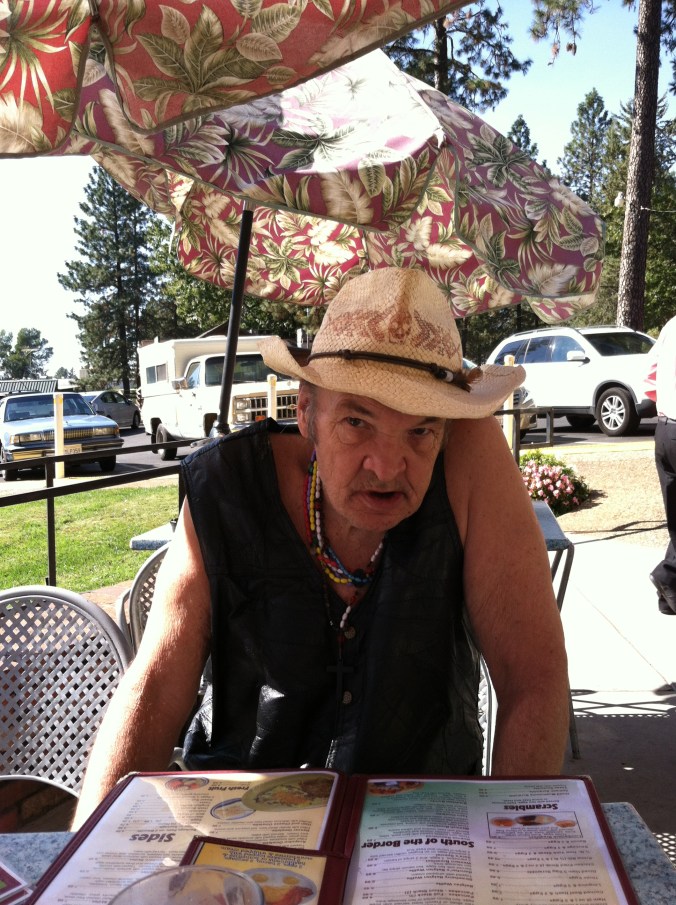
Electronic cigarettes, two singles for your weekly treat. Don’t forget a twelve pack of soda, and some canned goods. You should have enough instant coffee, but you drink coffee like water, only decaf for you. Costs more. If there is time, we go to Cozy Diner in Paradise. There is not a single entry on the menu less than one thousand calories. I know it is your day off, but I am getting fat. And then, we take our drive. A jaunt up the road through the trees.
You gaze at the trees and laugh loudly.
“See Donnie, they are all the same height!”
“They are all the same height! They are all the same height!”
“Ha! Ha! Ha!”
The Bells
Riding my bike in the park I saw a little girl in the distance. She was riding a brand new pink bicycle, purple streamers poking from the grips, steadied by training wheels under the watchful eye of her mother. She smiled at me still at some distance away; a big, puffy, heart-shaped pillow etched in lace centered on the handlebars, leading the way like a headlight. As she passed by me she again smiled not saying a word,
“Ring, ring,” chimed the bell.
She continued on moving slowly, teetering from side to side along the bike path. Her mother beside her, ever-present.
I passed by and rode off in the other direction, but I could not forget her.
“Ring, ring.”
Donuts
On some days Joe wants donuts. He seems to want specific kinds, but in the end he eats whatever there is. Chocolate, glazed, powdered, fritters, apple or blueberry, bear claws, he eats them all with abandonment, as if it were his final meal.
“I love everything God’s got,” he says.
The Hawk
We emerged from the parking lot through the blue, iron gate, and as we drove by a retirement complex across the street, I saw something. I could not believe my eyes; a majestic red tail hawk was resting on the lawn in plain view in the middle of the suburbs. It just sat there.
I point out the window,
“Look at that hawk Joe! He thinks he is a pigeon.”
The Premature Burial
An interruption to our happy rituals came suddenly last October, as all such interruptions do. It began with some news from my dear wife, who had also been visiting Joe—something about Joe’s leg. He was scratching it. My wife looked into it, and then I eventually got involved. Slowly the gravity of the problem sunk in. Joe needed to see a doctor.
Then, one rainy morning I took Joe to the Wound Clinic, and I got a glimpse of the trouble: ulcers and sores had opened all along Joe’s bad leg, from the ankle to the knee, right along the shin bone. This was no mere problem of dry skin and ‘picking scabs’; there was something internally wrong with Joe’s leg, crushed seventeen years ago.
The doctor caring for Joe was absolutely delightful, the sort of caregiver patients pray for. He joked with Joe and me, while meticulously examining the wound and explaining treatment. “Swelling is the cause,” he said. Internal injuries cause swelling. Swelling causes itching. Itching causes cuts and more swelling, and more serious wounds in a cycle. Eliminate infection. Treat and heal the wounds. Then, take steps to mitigate the swelling.
We had a plan.
In the months that followed, my wife and I took Joe to the Wound Clinic once a week to get his wounds cleaned and his bandages changed. After the Clinic, I took Joe out to lunch, and we talk as we always talk, drive as we always drive, laugh as we always laugh.
In the past weeks Joe’s leg got a little better, then a little worse. Then it got very much better, then a little worse. Now, after five months or so, it appears that the internal swelling will not allow the leg to completely heal. Life goes on. Suffering and joys are within limits.
But my brother will not allow limits. Love will not allow it. Boundaries must be crossed. Time itself must be overcome.
And so it is that one day, on a weekly visit to the doctor, Love peeked through a fold in time.
On that day Joe was in a joyous mood from the moment I saw him. As we drove around the bend toward the main street, he up righted himself and pointing straight ahead with a look of awe,
“Look at that! Ha! Ha! Ha!” he chuckled in amazement.
At first I did not notice anything–just a bunch of bushes across the street, and then I saw it. The sun had been out the past few days, and one bush had erupted in bright purple blossoms, shining against the backdrop of dozens of leafless, grey bushes and trees.
Life amongst the dead, I thought, or is it life among the soon to be alive.
Our light-heartedness carried on at the doctor’s office—it was one of those days. My wife joined us. The doctor himself was riding happy waves; and when the bandage was removed, I felt like yet another miracle had occurred; Joe’s once ulcer-ridden leg was almost completely healed.
“Alright Joe!” I exclaimed. Joe grinned with satisfaction under the brim of his little black cowboy hat.
“You’ve got new skin here cowboy,” the doctor said. “There is just one more place here,” he said, pointing to one last open wound. “That should heal up by next week.”
With all worry about Joe’s leg put to rest I struck up a conversation with the doctor. I don’t remember what we talked about—fanciful small talk.
Then, Joe interjected himself speaking in a loud voice, entirely uncharacteristic of him, as if he wanted to completely change the conversation.
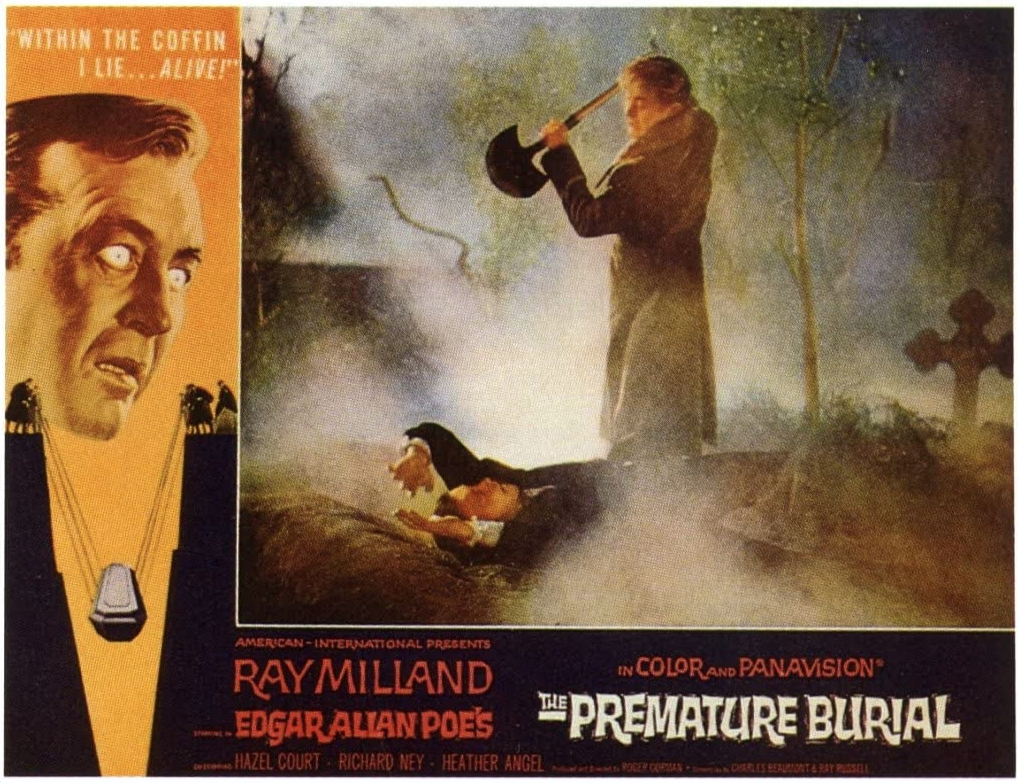
“You know Edgar Allen Poe. There is a movie about this story. A man is buried alive. And then he gets up out of his coffin and runs away! Ha! Ha! Ha! Ha!” Joe’s broke out in infectious laughter.
I laughed along with him, but I did not know why. Where did that come from?
The doctor and nurse seemed a little confused, but our laughter, and the joy in the room brought them to smiles as well. Then after a few seconds, the doctor broke into an Edgar-Allen-Poe inspired story of his own.
“You know, when I was in residency I worked in this big hospital with a few hundred patients. And at night people would die. People were always dying,” he said as light-heartedly as he could. “And I would get called in to pronounce people dead. So, I would check their vital signs and do what I was supposed to do. And then I pronounced them ‘dead’. But at night I would dream that they would come back to life in the morgue.”
“Yeah, I remember my friend got called to do the same thing one night. He was a new resident. His first time, and he didn’t know what to do. So, he came in and the family was there waiting. He stood at the end of the bed and raised his arms,” and as he said this he raised his arms like Moses parting the red sea, “and said. ‘I now pronounce you dead’”
As we emerged from that appointment, I felt what I have often felt with my brother—I don’t know how to describe it–something or someone pulling at me, demanding that I do something, a feeling that something has been planted in me, questions that require attention.
I have been listening to Joe’s stories, comments, jokes, delusions, speculations, lessons, advice for around forty years now. I have heard them all. And many of them I have heard hundreds of times, and that is not an exaggeration, and I cannot ever remember any mention of Edgar Allen Poe and the man who ran away from the grave.
Joe had ruptured the present. And the doctor had unwittingly and enthusiastically aided him; time and space had been torn and shards of love tossed into the air seeking resting places.
After our lunch, our drive, and our return to our lives apart, Edgar Allen Poe remained buried in my mind. And then, in a flash he rose again. What is this story? What is this film? Does it even exist?
****************************
In October of 1962 my brother Joe turned fifteen. I would turn five a month later. We lived in a house in the hills outside Oroville California, with our dear parents, and my little sister Paula, who was then two years old. My memories of that time past are serene, rolling in the tall green grass and flowers, smells of spring, playing in the rich, red dirt, throwing rocks, listening to birds, wandering on trails through bushes and trees, sitting in the dry, yellow grass of summer, basking in the sun. My father had a pile of loam dumped in the yard just for me—and I dug and dug until my clothes and skin were covered. He built a full-size basketball hoop, but it was too big for me. He taught me how to pitch a baseball before my little hands could even handle one—so, I used rocks instead.
“Bang!” A rock strikes a tree.
I did not know suffering as a child, except normal pains that come with earaches, fevers, coughs and such. Well-loved by my mother and father, growing up in the countryside, the kind of childhood parents dream out of love for their children.
My brother had drawn me from the present to the past, to 1962, the year that the film Premature Burial was released. The film was the third in a series of eight horror films directed by Roger Corman based on the stories of Edgar Allan Poe, including The House of Usher, The Pit and the Pendulum and the Raven. These were classic films that influenced the whole genre of horror to follow— Premature Burial is among the early influences on the cult classic Dawn of the Dead, released in 1968, the beginning of the zombie genre that flourishes in the present as never before—part of a global fascination with death, corpses, gore, atrocity, gruesome spectacles, apocalypse and dystopian futures of all kinds.
“Ha! Ha! Ha! Ha!” Joe laughed seeing the man run away from his grave.
The film departs in many respects from Poe’s short story, but neither the film nor the text is at all light-hearted. The main character of the film, like the narrator of Poe’s story, suffers from an obsessive fear of being buried alive. He hears voices and whistling and has visions of gravediggers that no one else can hear or see. He claims to suffer from catalepsy, an illness producing the appearance of being dead, while being alive. He builds a tomb that will allow him various means of escape, which he later destroys upon the insistence of his scheming wife.
The main character attempts to overcome his fear by opening the tomb of his dead father, who, he believes, was interred alive. The corpse of his father falls on him and he appears to die of a heart attack. He awakens in his coffin as he is being carried to his grave, unable to speak or move. Then, his worst fear is realized, he is buried alive.
Shortly thereafter a doctor orders an exhumation. As the coffin is opened the man leaps out. He kills both gravediggers, who, he believes, conspired to drive him mad. Then he runs off to seek revenge on others.
Viewing the film and reading the story drew me further into the grounds of the past, and I could not help imaging Joe as he was then–a teenage boy fighting seedling voices sprouting within—voices and figures with their own terrifying personality, part of him.
In his short story Poe personifies the irrational fears that haunt the main character in a dialogue of terror,
“While I remained motionless, and busied in endeavors to collect my thought, the cold hand grasped me fiercely by the wrist, shaking it petulantly, while the gibbering voice said again:
“Arise! did I not bid thee arise?”
“And who,” I demanded, “art thou?”
“I have no name in the regions which I inhabit,” replied the voice, mournfully; “I was mortal, but am fiend. I was merciless, but am pitiful. Thou dost feel that I shudder. — My teeth chatter as I speak, yet it is not with the chilliness of the night — of the night without end.” But this hideousness is insufferable. How canst thou tranquilly sleep? I cannot rest for the cry of these great agonies. These sights are more than I can bear. Get thee up! Come with me into the outer Night, and let me unfold to thee the graves. Is not this a spectacle of woe? — Behold!”
Poe’s story dragged me back into the past, into the hell that afflicted our family many years ago. My brother’s endless nights of pain, shrieking, blaring music, stench of cigarettes, beer cans, incessant, ominous grumbling, striking each one of us in different ways, draining my mother and father of hope, enveloping my sister in fear, and piercing my mind with the terror that I might be the next son to go mad, the innocence of a well-loved child covered over in pain and fear sinking into the ground, only to rise again.
Return to the Present
That morning, I had received mournful news; a close relative had died. He was such a vibrant, good man, and a dear friend. My cousin, his rambunctious, gregarious wife, whom I loved dearly, had died young as well, around ten years ago now. I grieved again for her, for him, for their daughter, who had sent me the news, for another cousin, for the whole family. I had been praying and praying that he be healed of his leukemia, an unlikely scenario for a man in his late 50s. I had real hope and faith. The brutality of nature, the realities of the present, closed in on me that morning, and the proud philosopher in me woke up; my love inspired faith was foolish and irrational, he said.
I went to a café to distract myself, read, write, and brood. I had just ordered a coffee and was walking to the end of the counter to pick it up.
A little girl, who was with her father some distance away, scampered toward me for no apparent reason.
“Boo!”, she shouted playfully.
When will I see you again?
“Ha! Ha! Ha! Ha!” Joe laughed as we talked about our springtime plans to barbecue in the park and have a couple of cold beers gibbering in his inaudible happy tones, and I laugh along with him.
In the cosmic tug of war between love and despair, love always prevails. And as the present moves ever forward, our love gets stronger. It wants to run away, like the man in Joe’s mind jumping out of his coffin.
But, as I have said before, Joe is always the same, really—although he has become quite accustomed to our weekly outings, which he now calls ‘his days off’.
“When will I see you again?” he always asks.
Poe and The Philosopher
Poe continues,
“the rigid embrace of the narrow house — the blackness of the absolute Night — the silence like a sea that overwhelms — the unseen but palpable presence of the Conqueror Worm”
True love resists and grows, spreading, taking root, pulling me toward love in the present and beyond the present, beyond time.
“Projections!”, the philosopher asserts, “A delusional escape from the terror of nothingness. The end of Being!”
Poe chimes in,
“Your hope arises from helplessness and fear—weakling, hypocrite, insufferable fool!”
Pride and knowledge are too big to see beyond time. I must be little, trusting and humble. An initiation in the hunt for tears and holes in the fabric of the present, to play, to peek into heaven. Science and knowledge fashion being and tell what there is, and what can be. Love’s delights, the antidotes, the substance unraveling concrete, turning stone into cloth, permeate the visible world. I learn how to find them.
Through the Veil
Purple blossoms against scratchy grey,
“Ring, ring.”
A donut feast.
“They are all the same height! They are all the same height!”
A hawk who thought he was a pigeon,
“Boo!”
In these I sense the truth; unbreakable threads, finer than silk, yet invisible, bind me to my brother, and to everyone else, in charity—and I will know that love has taken root in the ways I treat others— a web of love from which there is no escape. Creases and wrinkles in time toss up tiny hopes that only love can see, as mothers and fathers sense in the innocent baby talk of their darlings, crawling on the floor, flapping their arms, running in circles, dance-walking.
Veils on faces of the dying flutter in the wind and tempt the heart to flight; the self-covered to be remade, shattered to be formed anew, vanishing to reappear, dying to be born again, like a fetus in the womb of Love. Revolting smells remain bitter, separation is real and sorrowful, fatigue and malaise as natural as the flowers and trees. But Love reveals the veil, a pliable curtain, and probing its texture for meaning—that loss materialized wants to transform and fly away like a bird redeemed.
As one child healer innocently raises his arms in a spontaneous ritual to pronounce what cannot be said, mimicking the Christ before the tomb of Lazareth, as another good healer dreams of the dead reawaking, on the edge of time, like children drawn to the invisible truth. The good and loving God, I believe, will one day help our minds. In the meantime, my brother is with me, his being is mine also. He is in me and I in him.
“Bang!” a rock hits the tree, and I am like a child again, in the present blooming with roots pulsing from the ground, drawing on aquifers of suffering and broken heartedness transformed and cleansed in waters of love.
“Ha! Ha! Ha!” Joe laughs, as he sees the man run away from his grave.
Joe and God have remade the film and rewritten Poe’s story to transform the past into the present and beyond, to transform fear and suffering into laughter and joy–making Joe the man running from death laughing like a child at play into the hands of God.


 Songs for Joe