by Donald Felipe
Spring 2012
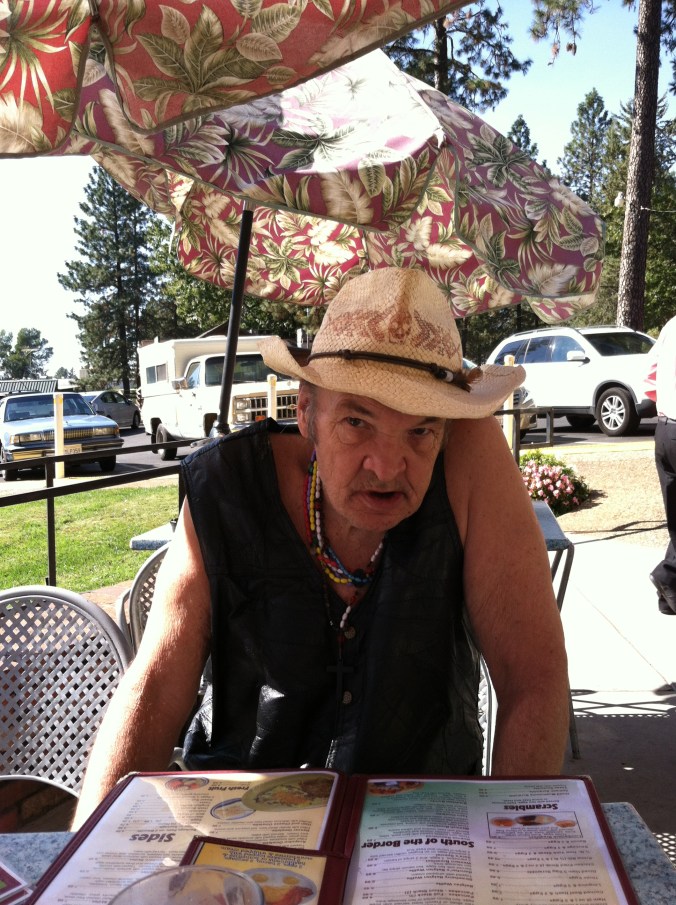
Paradise, California 2012.
I had not seen Joe for maybe five or six weeks. I have many dishonest excuses for not visiting. It is not that difficult to call and make an appointment, and Joe is not much trouble. He does ask for little favors, like cigarettes, a drive, lunch at a particular restaurant, maybe a visit to a department store to buy a shirt. But the requests are always politely offered and he takes refusals graciously, although he can be quite persistent in his requests for cigarettes.
I still experience reluctance and forgetfulness in arranging visits. “I have things to do,” I tell myself. But these tasks could wait or be put off altogether. Why do I neglect him? Are the visits more uncomfortable than they seem?
But I do visit Joe, I remind myself as I drive into the facility. I have been watching out for him for the past thirteen years or so. I promised that to my parents, who are now gone. Is it the promise that matters most to me?
It was the second week in May. I made my way towards the iron fence enclosing the facility. The air was dry and cool for this time of year. A gentle wind blew from the West and the sky was a clear, deep blue. White clouds meandered like heavenly cream puffs.
I readied myself to enter. The empty stares, the blank faces of dying minds, the smells of cafeteria food and traces of urine, the moans of imprisoned souls, these can shock at first.
I keyed in the entry code of the outer iron gate, marched up to the door and entered the building, one of two, sprawling, one story, structures. No one was in the main living area. I was dumbfounded. I stopped and listened for some sound from the kitchen. Nothing. Silence closed in on me, the only sign of human presence was the faint hum of an air conditioner rumbling in the background. The air was stale but fresh–the scents of the place had vanished. Where is everybody? I cautiously made my way to the kitchen and peaked around the corner.
Emptiness followed me. I was alone.
I turned around and gazed down the hallway extending from the kitchen to another living room about one hundred feet away. At the other end of the building I could make out a man sitting by himself in a large easy chair wearing a cowboy hat. It was Joe.
I skipped quickly through the living area and down the hall, it took a few seconds, and while I was still some distance away I greeted him.
Joe pushed himself out of the chair mumbling happily. Then, with his first step he stumbled a little.
“Are you doing alright Joe?” I asked, patting him on the back. “How is your leg?”
“I am fine Donnie. I’m fine,” Joe said in a chaffed, upbeat voice.
I stepped back and examined him. He was wearing pajama bottoms. Did he have trouble dressing himself that morning?
I came closer to Joe. His clothes were clean and he had showered that morning. The only coarse odor I could detect was on his breath, laden with scents of his rotting teeth and blackened lungs. He took a couple of steps and his limp again seemed pronounced. I cannot resist the thought that he is in pain. But there is never any sign of it in anything he says or does, except his limp.
We stepped outside into the warm sunshine and walked along the sidewalk bordered with green grass and flowers winding to a second iron gate a little further up. I kept a close eye on Joe. He trotted along in his normal fashion. As we made our way through the garden under the mild, May sun my worries subsided. I noticed some staff and a few residents lingering near the other building. I later learned that the facility was under new management and downsizing–all patients had been relocated there. Joe had returned to his former home and waited patiently for me where he knew I would find him.
I guided Joe through the gate to the car and in a few moments we were off. As we pulled away from the facility Joe made his requests, as was his custom.
“Donnie could we take a drive in the mountains and listen to music, maybe up to Paradise to Kalico Kitchen and sit outside,” Joe asked.
“Sure Joe. It’s a nice day to do that,” I said.
It was time to execute the routine. I turned the radio to the oldies rock station. No music. The station we normally listened to had changed. I searched for another station. I found nothing. Distractions attacked me. I had to take my daughter to the doctor and run other errands. The afternoon visit would have to be cut short. Was this a wish?
I punched at the radio with no success. My frustration escalated. Bursts of music and random noise rang out. Above it all Joe was talking in a loud, garbled voice, smiling joyfully, he glanced out the window one moment and in my direction the next. The absence of music to his liking didn’t seem to bother him, but I worried that would change, so I kept looking.
He turned to me and mumbled seriously with pleading eyes. God was telling him something and he wanted me to know about it. It was time to give up on the radio and go into a listening mode, a habit I’ve developed with Joe. In listening mode I nod my head at whatever Joe is saying, smile, and say, ‘yeah’.
A scratchy mini-lecture of about twenty seconds went off right on cue. It was something about God, warehouses and resources in the ground. I had no idea what he was talking about.
“Yeah,” I said.
Joe belted out a few knowing chuckles, as if the joke were on me, then he looked back out the window and returned to private conversations beneath his breath. I resumed the hunt for music. Finally, I found something, the Rolling Stones. I turned up the volume. Joe bobbed his head in approval. Relief. We rocked down the road. The day seemed to find its true course: lunch, a drive, daydreams and random thoughts for me, endless dialogues for Joe, under rock and roll rhythms.
Joe would live in his world, and I would dream in mine.
We travelled along the Skyway, a thoroughfare ascending the ridge from Chico into the foothills of the mountains to the town of Paradise. The Sacramento valley came into view to our right, green rice fields and orchards spread up and down the middle, along the Sacramento River running north and south for as far as the eye could see. Surrounding the lush green valley were the dry, yellowish brown summer grasslands of Northern California spreading in the distance to the far off Pacific Coast Range, whose magnificent forms loomed to the West. The old music brings on a dreamy nostalgia that overcomes me. Joe strums an air guitar and memories from my youth pass before me like the hearty oaks sprouting from the volcanic rock of the ridge receding from our skyward vision.
But God did not want us passing our time like that today. Joe tried to raise his voice above the music, and this time his eyes gleamed with intensity. He was doing his best to enunciate his words. I turned down the radio. Listening mode would not be enough this time.
Again Joe said something about God, and resources, and what God was doing with them; the warehouses were put in the ground, he said, or something to that effect. He smiled at me awaiting a response or some acknowledgement
“That sounds about right, Joe,” I tried to say with an honest air.
Laughter exploded from his belly. His eyes lit up with joy. I could not help but smile, as if I had brief permission to play some unsuspecting role in this divine comedy.
We have had so many exchanges like this over the years. Following the laughter Joe mumbles and chuckles, and will sometimes repeat phrases for a while. For a few seconds I am part of it all, whatever it is, and as the laughter wanes my separation from his world increases, until we return to our former condition, my dreams of distraction, his divine dialogues that never cease to amuse.
But not today. Not one song on the radio had passed before Joe invaded my space again with a demand for attention. He turned to me and spoke in the clear, sober voice of a friend.
“You know Donnie,” he said, “I just love riding in the car and listening to music.”
I nodded, but not from mere acknowledgement. I agreed with him. The music of our youth, the passing motion of oaks, pines, blue skies, rocks, the reddish brown earth of the foothills, sights, sounds, and smells of our Northern California home, all these we shared as brothers. Joe had set aside his friends and God to say ‘thank you’.
We approached our destination, Kalico Kitchen, a homey, American-style restaurant along the main street, the Skyway, in Paradise California. Joe used to live right around the corner from this restaurant. Before his accident, Joe frequented this place. In the front of the restaurant was a concrete patio with plastic tables, metal chairs and umbrellas.
We took a seat. Our waitress, a large woman in a black dress and ruffled white blouse handed us menus.
“Can I get you anything to drink honey?” She said gruffly.
“Just water,” I said.
“Water, water’s fine,” Joe said.
Joe immediately attacked the menu scanning the pages. I don’t know what Joe sees and thinks when he looks at a menu, but he takes great care, and orders just what he wants.
The waitress hovered over us like an inquisitor. Joe rattled off his order in his scratchy voice. I leaned over and listened carefully, ready to translate if needed. He wanted prime rib, fries and a chocolate milkshake.
When the waitress heard ‘chocolate milkshake’ she hesitated, as if she disapproved. I had not seen a chocolate milkshake on the menu. She paused and studied Joe, then she smiled,
“Alright honey.”
I placed my order and reclined to the extent I could, and focused attention on the sun and the tall evergreens that lined the street and surrounded the restaurant. A soothing May sun fell upon us like a clean sheet. Joe lost himself in peaceful mumbling, and my mind was again set adrift.
It did not take long for the waitress to arrive with the milkshake. A decorative glass was filled to the brim with a straw placed squarely in the middle, and next to it she placed a tall, silver, metal cup, which was almost half full. She dropped an additional large spoon into the metal cup as if to invite Joe to share with me.
“I made this myself, and I make a great milkshake,” she said. Her gruffness had disappeared. She almost spoke like a mother.
Joe dug in.
This is too good, I thought, He can’t eat all of this. I asked permission to take the metal cup.
“Donnie, you go ahead, go ahead.”
The milkshake was beyond this world, rich, smooth ice cream and milk with just the right amount of chocolate, not too sweet, without a hint of bitterness. Heavenly.
We devoured the shakes in a minute or so, and with every scoop and draw my mood elevated. Not a word passed between us, but I was drawn closer to Joe. The shared enjoyment of this unexpected pleasure had built a bridge between us and when we had finished, conversation seemed natural. But sustained conversation of more than a minute or two is difficult for Joe. I have a way of engaging Joe with little stories about the family. And so I did. Joe graciously listened, as he always does. He tried to stay engaged for as long as he could. Then he asked something quite unusual. There was a large sign across the street advertising a charter school. Joe asked me what a charter school was. He had read the sign. I did my best to answer. He nodded as if he understood.
Silence was building between us again, normally a prelude to a return to dream. But we both remained present to one another. The milkshake, the sun, the fragrance of spring, I don’t know what kept us together. But the silence seemed to bring us closer this time.
Then Joe’s demeanor suddenly changed. His being relaxed and gentleness washed over him. His face seemed to brighten. I could see clearly the smoothness of his cheeks riddled with deep valleys of wrinkles. He leaned forward, his face coming nearer to me. His tender eyes led the way, clear, pleading, full of compassion. His entire countenance had transformed in a few seconds. I sat there empty, not knowing what to expect. His eyes reached mine, and he spoke effortlessly in the clarity of space that contained us,
“Love one another as I loved you,” he said sweetly.
He reclined and in a few moments returned to his former self. His words seemed to pass through me, washing away any lingering distance between us. But I did not know what to think. I was a witness and nothing more to something remarkable. But what? There was something that I hardly sensed at the time. What Joe said, what he had done, had changed me in some way. I could not stop thinking about it. I could not stop my curiosity. Where did that come from? Why did he say it? What did it mean? These questions set themselves aside as we finished our lunch, but they would return.
The rest of the day proceeded as most of our days do. After lunch I drove him back to the facility with oldies rock pounding away at high volume. Joe grooved to the music. I escorted him through the gate and gave him a little hug
“God bless you Donnie. God bless you,” he says.
Days passed. A question had taken root and demanded answers.
I wanted to ignore the theological context of what Joe had said. “It was him,” I kept thinking. The soul that came to me in those words, in that moment was my loving brother, his essence, his power and strength, the will that had brought him out of decades of torment to a life of peace and faith, an unstoppable love.
It was him. He had endured, and for a few precious seconds he was restored entirely.
But the words were too perfect. And no words have ever been spoken with more conviction and loving intent. I got out the New Testament and looked up the passage, John 13. I rarely read the Bible and did not remember the chronology and details of the story. Jesus gets up from a meal with his disciples, takes off his clothes and wraps himself in a towel. He pours water into a large bowl and begins to wash the feet of all the disciples, including the scheming Judas, and passionate Peter, who at first refuses to allow Jesus to behave like his servant.
“You will later understand,” Jesus says.
He puts his clothes back on and returns to the meal. He declares that one of them will betray him. He privately identifies Judas and tells him to do what he must. He tells the rest of them that he will not be with them much longer, then, he utters his final teaching, what he says is his only commandment:
“Love one another as I loved you.”
The words were a perfect match with what Joe said. I had to look at the Greek. I had studied the Greek language for several years in my youth. My interests were philosophy and literature. The language of the New Testament, the primitive koine, the language of Hellenistic bureaucrats, never appealed to me.
And the story plays out in the koine in choppy simplicity, like storytelling for children. But the tenses in the commandment itself form a conceptual whole. “Love one another” is a present tense command with a continuous aspect, open-ended, “as I loved you” is the aorist tense, in a timeless aspect denoting the finality of a past event. The idea of the aorist tense attempting to contain the finality of that act, the act of the master becoming the servant, the act of love and sacrifice, and all that that might imply, brings me back to Joe.
The simple, crude veneer of the Greek text is only a layer that both represents and hides others, and the root of layers of language is an act of service and love at a meal among friends, first century Jews, gathered before the Passover in Jerusalem, speaking another language entirely.
It is at the level of action, the root of the language, visible and intelligible to us that I see the power of the so-called commandment, a commandment that is no commandment at all. Actions are not language. Love is not language. And all commandments require language.
The act of love is like a resource underground, an aquifer, nourishing history and language that are visible, just as the soul of my brother is a resource of sorts, animating his diseased and broken body and his damaged brain.
Joe was right. God put resources underground.
The context of the command also brings me to Joe. The roles of servant and master are reversed and then annihilated. “It is right that you call me rabbi and lord,” says Jesus, but his role as teacher and lord requires stripping away any sign of status, to become naked, and serve like a slave for those he keeps in his heart. Only love warrants status, only love keeps, and love requires the obliteration of status, of our normal assumptions and conventions.
On the one hand, I appear to be one of Joe’s masters, his superior. Without me he would be unable to go out for lunch. I pay for his conservator. I watch out for him. I am educated, literate and strong. But this role has dignity only insofar as I love him, only insofar as I act to care for him. Without love my strength has no purpose, and falls into the dangers of cruelty, meanness and self-indulgence. Without love I become base, inferior, and lost.
And in his actions and utterance that day, Joe served me, he taught me. Through some extraordinary and divine act of will he traversed the natural separation of body and mind to love me, and that love is a mystery that continues to grow like from a seed, from touch, to germination, to budding, to appearance in the world, love from his soul to this page.
But Joe could not do it on his own. He needed help. The sky, the rolling clouds, the luminous warmth of the spring sun, the motherly affection and diligence of a waitress, and the heavenly flavor of a milkshake. In the littleness of things love grows in unexpected ways and that littleness involves us all and all that surrounds us. It involves everything.
Herein plays out the irony and paradox of a divine ethic, born in the action of Jesus, born in the actions of my brother.
ROSELEAF GARDENS
In the spring and summer of 2012 I did not know that the care home where Joe was staying had changed ownership. That is why the building was vacant, and Joe was not in his usual place when I came to pick him up that day. The new management renovated the facilities, and within a few months the atmosphere of the place had been transformed. A lightness seemed almost tangible in surroundings that had felt heavy before. It was as if a new day had dawned for this care home, a happy new day. The new assisted living home specialized in memory care, and somehow Joe, a schizophrenic, had been grandfathered in as a permanent resident.
The new home had a new name, which I did not come to know until December of 2013.
The name of the home was ‘Roseleaf Gardens’.
 Songs for Joe