by Donald Felipe
(NOTE: Most of the following essay was written on November 22, 2012. The events in Vienna occurred on November 7, 2011.)
I arrived in Vienna late in the evening around ten o’clock on November 6th after fourteen hours of travel from San Francisco. I managed to navigate the local trains to my hotel on the outskirts of the city center without trouble. I got to bed around eleven thirty, but I had difficulty sleeping. My paper, ‘The Book of Joe’, was not yet finished and I was presenting it in four days. Most of the paper was written. I had completed a general account of Joe’s life, his breakdown and transformation, but I felt dissatisfied with it. I was not sure what to say at the end. A simple narrative would never capture whatever the aim of the paper was. And the story had to be about him, not me. But I didn’t know how to get myself out of the way. Joe himself must be made present to an audience, I thought. But even that was not enough: the meaning of Joe’s life, whatever it was, should be revealed. I found myself turning to poetry here and there, and occasionally I would write something that seemed out of the ordinary. It was the meaning of Joe’s life that mattered, I repeated to myself. But what was that meaning? Was the meaning of Joe’s life simply a matter of my own interpretation? Or perhaps I was lying to myself in saying that I wanted the paper to be about Joe. Maybe it was all about me. If it was about me, then I did not want to write it. What right do I have to define the purpose of my brother’s life? I rolled over in my mind again and again the purpose, the meaning of the paper, the meaning of a life.
I awoke around eight o’clock, languishing in jet lag. A shower, a hearty breakfast in the hotel restaurant, and my grand expectations for the day brought me to life. By around nine thirty I was ready. My concerns about the paper were set aside. I had only one day to see Vienna and I had a plan. From the hotel I could walk to two nearby 17th century churches and get a feel for the streets and byways of the old city. I would make my way to Saint Stephen’s cathedral in the city center, and from there I could visit the Mozart museum and the Jewish museum nearby. Then I would walk out to view the grand architecture of old Vienna. After that, if I had any life left in me, I wanted to head out in the direction of the Freudian museum and a few other churches in another section of the city.
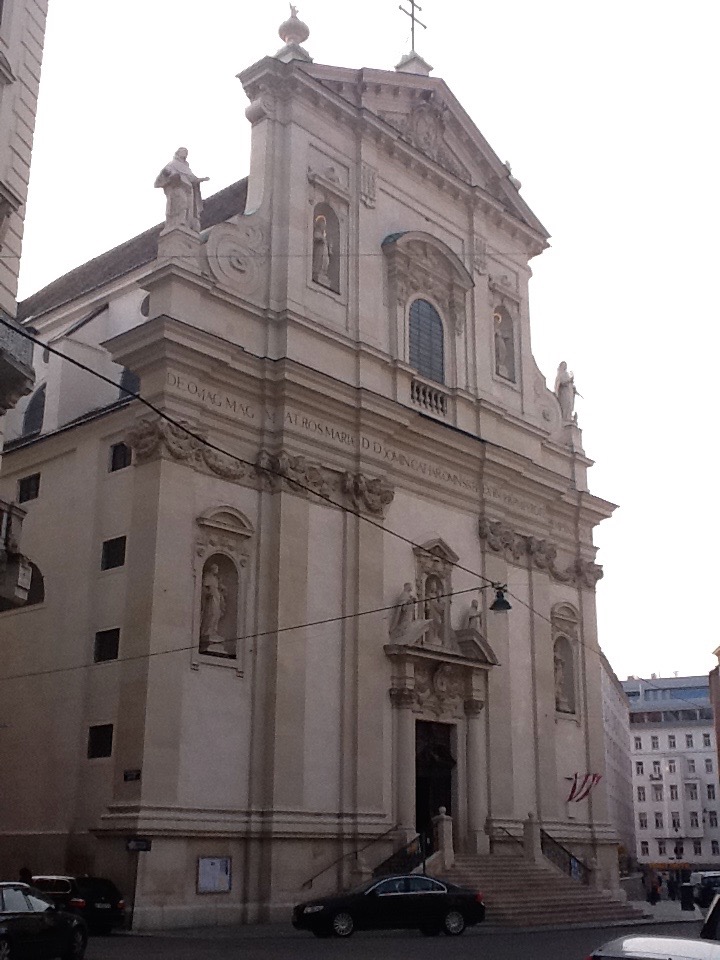
With my rucksack on my shoulder provisioned with water and my iPad, I set off. The day immediately came to a fortuitous beginning. I came upon the Dominican Church, an unassuming structure from the outside. I noticed someone coming out the front. The church was open. I tried the thick, dark wood door and it glided open. Not a soul could be seen or heard. I proceeded cautiously through the foyer. I could not believe what I saw. A beautiful baroque interior in an early 17th century style, pews carved from enormous trees and stained a dark chocolate, brownish-black. I made my way to the middle of the church examining the paintings, statues and carvings. It took a few moments to realize that I was entirely alone. In the front of the church to the right there was an early Baroque depiction of Madonna and child. I sat down on the hulky pews and gazed at the surroundings. Time passed and the church remained utterly silent. No one entered. I remained alone in that lovely, divine place. My mind silenced itself. There was too much to see, too much to think about, if I looked around with intention. So I banished my thoughts and sat for the sake of sitting. I had just begun my day, which would involve long walks through this wonderful city, and I was already tired.
After about fifteen minutes or so I got up. I was still alone. All was quiet. And that is how it remained as I left.
I was a block or two away before I realized that I had not taken a single photo. But I did not care. The images were indelibly imprinted in memory where they remain to this day.

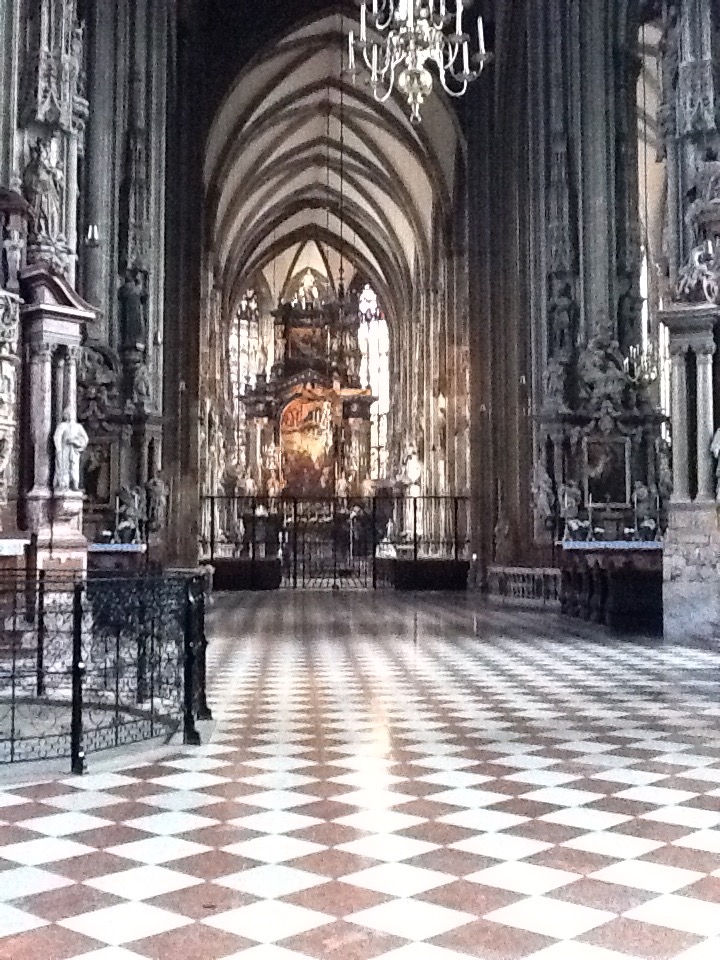
After a quick visit to the Jesuit Church, which was far less charming, I walked to Saint Stephen’s, the grand medieval, Gothic cathedral, the heart of old Vienna. I would not miss the opportunity for photographs this time. I clicked away at my iPad picturing the exterior of the Cathedral from various angles. And then I climbed all the way up the ancient, stone stairwell of one of the steeples and took in vista of the city expanding in all directions. I came down from the steeple and made my way to the front of the Cathedral. The solemn, majestic interior of St. Stephen’s embraced me like an old friend–the tall, cylindrical stones towering high above, the glimmering, rectangular tile floors, the exquisite artwork. The center of the church was blocked by a wrought iron fence and gate. Mindlessly I wandered down the left corridor of the church gazing at the surroundings. A mass was being held in front, so I kept my distance. I turned around and walked back to the front. On the right side of the church was the Maria Pötsch icon, a rope surrounded several rows of pews and chairs in front, and there were several people praying. Tourists bustled in and around the church in a constant stream, but somehow that did not diminish the experience of reverence in that place; in the tussle between faithless curiosity and faithful prayer, prayer seemed to be the victor, absorbing the curious unto itself and leaving them with something they did not possess before they entered.
It took me a while to notice a little shrine to the left near the entrance of the church. It was plain and mundane compared to the artistic, historic surroundings. A black and white picture of a nun, who seemed familiar, was hanging above a simple altar, and next to her was a text in German. I moved closer to read it. The author was “Saint Teresa”. The German text was flowing and simple, an easy read. And how beautiful it was. “Love was the heart of the church,” it said, “love is all.”
I could not place this saint. There is no German or Austrian Saint Teresa, I thought. Who is she? I read the passage again. It seemed even more lovely the second time. Who is this ‘Teresa’? I stepped back and with my mind in overdrive running through my very limited knowledge of Catholic Saints. There is no German Saint Teresa, I concluded.
Suddenly I noticed a woman standing very close to me. She was short and plain looking, unlike many of the fashionable ladies, young and old, meandering through the church. She very softly started speaking to me. I did my best to listen and piece together what she was saying with my rusty German. She said something about how much she loved the church, and how it was like her home. She spoke slowly in a rhythmical simplicity, as if her mind moved in such ways. She was so courteous that I felt the need to reply, but I did not know what to say, or what I could say with my poor German.
“The Church was indeed beautiful, very beautiful,” I said, or something to that effect.
I expected her to move on. I obviously had little to say, and my attention was fixed on the little shine. My body language should have indicated that she was bothering me a little. But the woman humbly and quietly stayed by my side, like a loyal friend. It would have been rude to say nothing to her, so I started wondering out loud about the picture of the saint.
“I know her,” I said. “What is her name?”
That was stupid question. Her name was ‘Teresa’. It said so on the wall. I tried to rephrase the question clumsily.
“What is her last name?” I asked.
Another idiotic question. Saints are not known by their last names. I tried again. I do not remember what I said, but it was just as senseless. The lady seemed to want to help me, but she herself seemed small and out of place. Then she spoke to me directly in the most slow, and matter of fact tone,
“Sie is tot,” she said. (“She is dead.”)
What a foolish thing to say, I thought. Of course, she is dead. I could not help myself. I just blurted it out,
“Yes, of course.”
The lady seemed to withdraw from me a bit, and I immediately regretted what I said. Her behavior and childish remark seemed to indicate that she was mentally diminished. But she treated me with such graciousness. I began to pity her. I wanted to at least say something out of politeness. But my German was not working, and I was too busy trying to deduce the identity of the saint. In a few moments she wandered off. I thought that she had gone. I remained before the shine attempting to solve the puzzle.
“Who is she?” I continued to ask myself.
Out of the corner of my eye a little figure came marching toward me. It was the little woman. She extended her arm. She had a book in her hand. Then she very carefully and slowly spoke in simple, crystal-clear German.
“This will tell you what you want to know about the Madame,” she said.
I looked at the cover of the book. It was a fairly thick, glossy magazine of some sort. If this were a picture book about the saint bought at a local bookstore it would not be cheap. This lady certainly did not have much money. I could not accept that kind of generosity from her. I tried to politely refuse the gift. She became insistent and extended her arm closer to me, as if it would be an insult to her if I refused. I reached out and gingerly grasped the book and nodded to her a ‘thank you’.
As soon as the book was securely in my hand, she turned and sped off. I glanced at the cover. The book appeared to be some kind of home and garden magazine that had nothing to do with the saint. I became concerned for this woman. I followed her with my eyes. She quickly walked to the other side of the church, and marched confidently up to a wooden door that seemed to provide passage to the interior of the church on the right side. She tried the door handle as if she lived there, but the door was locked. She abruptly turned to her left, walking quickly along the side of the church until she disappeared from view behind the Maria Pötsch icon
I opened the book and thumbed through the pages. My initial impression was correct. The book was full of glossy pictures of gardens and luxury homes. It was not a picture book, but it would not be inexpensive in a city like Vienna. The woman had generously given me a book that must have been valuable to her. I could not help but think of Joe. I pitied the woman even more. She had been so generous and thoughtful.
I stuffed the book into my bag, unsure what I was going to do with it. It was a little heavy. I pondered the mystery of this saint’s identity for just a little longer. The Internet will solve the problem once and for all, I thought. No more need to linger.
I left the church and continued my excursion to the Mozart and Jewish museums. The Mozart museum was enjoyable. Besides the music and the history of the flat where Mozart lived in Vienna, I took comfort in the café on the first floor, which allowed me a few minutes to rest and have a coffee. Fatigue gnawed at me.
I made my way to the Jewish museum next and was horribly disappointed, even sad. I hoped to find information about the long history of Viennese and Central European Jews, their persecution, their intellectual and cultural contributions. There was one minor exhibit on the Holocaust and a whole floor devoted to the accomplishments of Central European Jews in Hollywood. Multimedia, movie posters, I felt like I was in Los Angeles. On the top floor were a few cabinets enclosed with glass with candlesticks and other artifacts from synagogues that had been destroyed during the reign of the Third Reich. Was this all that was left of the old synagogues of Vienna? The walls of the museum were painted a bright white, a fitting color, I thought. The purpose of the museum seemed to be to be bright, not dark. Hence a shiny whiteness washed the walls. Was there nothing to display? Had the Holocaust so completely erased the Jewish presence and memory in Vienna that there was nothing more to say? Was the Holocaust so painful that the spectacular distraction of Hollywood movies had become the antidote?
I made my way toward the palace and administrative buildings of the Hapsburgs clicking away at the architecture. I walked and clicked, walked and clicked for at least an hour or two. My legs were getting soft. My joints were aching, and a walking drowsiness was overtaking me. I needed to sit down. I was not going to make it to the Freudian museum like this. I would be lucky to have the energy to walk back to the hotel. In my mind I ran through the tasks that were necessary before my trip to Prague. The Czech Republic was not in the Euro-zone; I needed to change money. I checked the map and started walking in the direction of the hotel, looking around every corner up and down the street, hoping to spot a place to change money. I passed by more magnificent architecture, and encountered quite a few tourists like me snapping away at their cameras. My legs weakened further. I had to sit down. I spotted a bench on a corner that also had a view of a beautiful archway and statues. These would have impressed me earlier in the day, but the bench meant far more to me now. An older woman sat on one side of the bench. I examined her as I approached. She was well dressed and appeared quite civil from her demeanor, the kind of person that would leave me in peace. So, I sat down on the other side of the bench and quietly let out a sigh of relief.
We sat there together in silence for a few moments. The lady was living up to my expectations.
Then she abruptly changed that. She pointed to some tourists across the street taking pictures of the statues and buildings.
“Why do they do that?” she asked. “Why do they take pictures?”
She scoffed at the tourists disdainfully. This lady had some spunk. I had to respond in some way to avoid being rude. I did my best to say something civil.
“I take pictures so I can share them with my wife and daughter when I get home. That way I can share my trip with them, as if they were here,” I said.
“Ah!” She scoffed again, obviously unimpressed. This woman had some strong opinions, but she did not appear mean, and she still wanted to talk. She picked up her chin.
“At the market here,” she protested, “there are four hundred different kinds of cheeses.” She flicked her fingers in the air as if to bush it off as some kind of absurdity.
“Ah! Take me back to the war!” she said.
From pictures to cheese, to war, I did not know what to think. I was again obliged to respond, not knowing what to say. The lady did not look that old. I surmised that she must have been a child during the war. Perhaps she had painful memories.
“Where are you from?” I asked.
“I am from Canada,” she said.
“But you were here during the war?” I asked.
She nodded, “ I am from Normandy.”
She promptly launched into another tirade.
“Fifty thousand dead! Fifty thousand dead! Churchill, I hate him. Ah! He bombed all these German towns. Fifty thousand dead!”
Proudly and bitterly pursing her mouth, her finger held high again:
“We will never forget!” she said.
The lady was becoming agitated. I tried to calm the conversation,
“It was a horrible war,” I said.
She paused and swallowed her breath. I was not thinking clearly. I suppose I wanted to change the subject and guide the conversation to some philosophical plane that I found interesting. My experience at the Jewish museum was fresh in my mind, and so I made a clumsy attempt at sharing.
“I visited the Jewish museum today…” The lady would not allow me to continue.
“Ah!” she scoffed again. “I will not go there. You did not have to be a Jew to be killed!” She said, shaking her finger in the air.
The lady had finally broken my patience. She was not the gentle lady she appeared to be. Bitterness and hate filled her soul. As much as I needed to rest my legs, I could not tolerate sitting next to her any longer. I got up and spoke as kindly as I could, allowing the sharpness of my movements to express my displeasure.
“I must find a bank to change money. I must go. Goodbye.”
I walked away. I glanced over my shoulder to have one last look at her. With her chin held high in the air, proudly, she looked in the other direction. I continued on my way and did not look back. I rounded a corner and did my best to put her out of mind.
I made my way back to the main pedestrian zone of the old city and visited one more church. I was lucky enough to enter in the midst of an organ recital. I changed money and as I approached Saint Stephen’s fatigue set in full force. I walked back to the hotel, another ten minutes or so, and laid down in my room. I awoke and it was dark outside.
Out of curiosity I again pulled the magazine from my backpack and looked it over. The lady in Saint Stephen’s had so earnestly and sincerely told me that this book would tell me what I wanted to know about the Saint, and she was such a sweet lady. Maybe there was something I missed. But I did not find anything new. Luxurious furniture, clothing, floral arrangements, gardens; I did not bother trying to read the German text, which appeared to be the sort of thing one might find in a Town and Country magazine back home. The magazine was just what it appeared to be, or so I thought. I did not see any point in keeping it. I was already weighed down enough with books, clothing and papers. I set the book on the desk in my room. It was too nice to throw away. It had been such a generous gift, but it was useless.
I walked to a nearby restaurant. I had a meal and some tasty Austrian beer, then back to the hotel. I took a shower and climbed into bed. The train left for Prague fairly early. I would have the late afternoon and evening to settle into Prague. The conference would begin the next day. I still did not know what to do with the conclusion to my paper. As I lay in bed that night, I could not get the lady from Saint Stephen’s out of my thoughts. She reminded me of Joe. She appeared to have so little. But she wanted to help me. Or was she just grateful that I had talked to her? In any case, she had given me what she had. Her world seemed to be one of dreams, delusions and alienation. She left me with exactly the opposite feeling from the lady on the bench, who did not care about my feelings or needs. The lady on the bench wanted to impose herself on me, to speak without listening. The lady of Saint Stephen’s had nothing remarkable to say, and she appeared to be aware of that. All she did was listen and give. Pride and humility, meanness and compassion, bitterness and gratitude, the contrasts between the two of them mounted.
That day in Vienna, besides requests for directions and a few transactions, checking into my room, changing money, ordering food and drink, I spoke only with these two people, the ladies of Vienna, as I came to know them. I thought nothing of it at the time. Vienna was such a beautiful city, and in my jet lag I had managed to see much of the old city. It was a good day of sight-seeing. But these ladies left me hints and clues to an unknown horizon. I did not know it at the time, but in the littleness of these clues I had been introduced to the very Saint whose identity had escaped me, a Saint who would change me.
The next morning I packed up all clothing, toiletries, books, iPad and papers and got ready to leave. The magazine was still on the desk. It was useless, I concluded one more time, but too nice to throw away. I left ten Euros on the magazine as a tip for the cleaning ladies. Perhaps they might enjoy it.
I checked out of the hotel and left.
I had left the adapter to plug into European electrical outlets in the hotel in Vienna. I was writing my paper on the iPad, and the paper was not finished. As soon as I checked into the hotel in Prague I raced to a department store to buy a new adapter. After some confusion, and a lot of walking around, my hunt met with success. I barely had time to unpack and access the WiFi at the hotel when it was time to go out to dinner with my colleague Nate. I read my paper again. It was entirely inadequate. I want the audience and readers to see in Joe what I see, I thought.
But what do I see?
There was no more time to think that evening. It was time to enjoy. I met Nate at a restaurant in the old city and enjoyed a good meal and more very good beer. Prague and Vienna, such marvelous cities, and I had been granted the great blessing of visiting them both in such comfort.
I returned to my room a little euphoric from the beer. I sat down at the desk and turned on my iPad. I was in no state of mind to write. But I could browse the Internet. It was now time to solve the mystery of the Saint at Saint Stephen’s. She was not German. She was probably not Austrian. The photo looked 19th century or so. Her name was ‘Teresa’. I searched and browsed pages in a confused fashion for a few seconds. Then I found her. No wonder! She’s French! Saint Thérèse! I hunted further, and brought up her biography. She was from Lisieux, in Normandy.
The lady on the bench!
I read on. Saint Thérèse was known as ‘the Little Flower’, a doctor of the Catholic Church, and yet she died at the age of 24. She was not a scholar, not that well educated. She said that she wanted to be little. And she loved. Oh, how she loved! In her life she practiced this love in every little act and intention of daily living. This she endeavored to teach.
What a beautiful Saint! What a match for Joe! What a match for the lady of Saint Stephen’s! And what an opposition to the lady on the bench. The contrasts and oppositions, irony and paradox, filled my mind anew. And she was from Normandy. In the beauty of it all I began to cry. The meaning of my brother’s life was a mystery, hidden in irony and paradox, hidden in love. The little Saint looked at me from the screen of my iPad and seemed to tell me that. I did not yet know this woman. But how lovely she was.
In her I knew I would find my brother.
I slept that evening with tears streaming down the pillowcase, and reviewed in my mind every sentence, every moment of those experiences with the ladies in Vienna. That evening in Prague I committed it all to memory, where it resides to this day.
The events of Vienna carried immediate significance for me, as well as hidden meanings. In the little lady I saw Joe, I saw Saint Thérèse, and in the lady on the bench I saw the opposite. I saw love opposed to hate, bitterness opposed to compassion, self assertion opposed to patience, disregard opposed to care, pride opposed to humility, charity opposed to self concern. And yet the lady on the bench was from Normandy, the birthplace and home of Saint Thérèse herself.
“But she is dead,” I thought, just as the lady in Saint Stephen’s had said. She no longer resides in Normandy. The flowers and gardens of the magazine acquired meaning as well. Saint Thérèse loved flowers, and was known for leaving roses in response to prayers. I wanted to have the book back to examine it. But it was gone, just like Thérèse herself. I had given it away with ten Euros for the cleaning ladies. I flirted with claims to charity, but that would be a lie. The book was too heavy and I did not want to carry it. Now, I wanted it back.
The comment about the cheese as well seemed to have some ironic meaning. The bitter lady on the bench was not open to limitless choice and pleasures. She was fixed on the familiar, sameness. She wanted to go back to the war. But why? Did her bitterness prevent her from opening herself up to what is new, different, the unexpected? Joe’s mind was diseased. He could not think complex thoughts. But in his delusions he enjoyed limitless possibility, and continuous joy. He was imprisoned from the normal, human perspective, and yet he was free and joyful. The biological and material limitations could not contain his spirit. He roamed blissfully among worlds we cannot know.
Was this part of what he meant when he says, “I live with God”?
The openness of Joe’s life coalesced with his compassion and charity. These belong together. His heart beats with such concern for others, which he expresses in ways that he can, just as the little lady of Saint Stephen’s did what she could for me. Is this also an aspect of life with God?
The night before I was to present my paper I sat down at my desk and wrote out a series of ironies attempting to unravel the mystery of the meaning of my brother’s life with God. Did he really live with God? How could I say he did not? How could anyone say?
******************
I returned to Vienna after the conference by train in the afternoon. My plane left for San Francisco the next day. I checked into the same hotel, and was given the same room. In the room I found my adapter still stuck into the electric socket. But the magazine was nowhere to be found.
I had just enough time to make my way back to Saint Stephen’s and view the shrine of Saint Thérèse one more time. In the Cathedral store I found a little card with the same photo of Thérèse with the German text on the back. I bought four cards, and a rosary for Joe, and went out to dinner.
Upon my arrival home I was excited to tell my wife about the experiences in Vienna, the reception of the paper, and the ideas still fresh in my mind. I told her about the shrine, the lady of Saint Stephen’s and the lady on the bench. She listened intently with tears in her eyes. Then she said quietly,
“I have been praying a Novena to Saint Thérèse for over a year.”
She pulled out a laminated, black and white card. There she was, Saint Thérèse, the very same photo at the shine in Saint Stephen’s. It was a special card with a tiny piece of red cloth laminated on the back; the cloth had been touched to her relics. It was a gift from a high school friend of hers. My faithful wife had been praying for months on end without my knowledge. But she was always praying, by the fireplace in the morning, in her office. That was what she did. I never asked her about it.
POSTSCRIPTS
AFTERMATH OF VIENNA
In the aftermath of this trip I was uncertain what to think and believe about what had happened in Vienna. To the very core of my being I felt that something extraordinary had taken place.
But what?
I began reading all the works of Thérèse, her famous autobiography, The Story of A Soul, letters, poetry, plays; she was quite prolific for a cloistered nun who only wrote with permission from superiors. I stayed away from hagiographies and other books and articles about Thérèse. In Vienna I could not escape the feeling Thérèse had introduced herself to me, as well as to her opposite, who ironically hailed from her earthly home. Ironies and opposites bubbled up like signs. I cannot help but crack a smile when I think of it, “You want to know who I am? See this bitter woman from my home? Well, I am not her!”
I did not want to read what others said or thought about Thérèse. Her own words were required. And how touching, transparent, and true they were. If one attends carefully to the writings of Thérèse, no matter what your opinions or beliefs, one cannot escape the depths of soul from which every word springs; she says only what she thinks, nothing more or less, with a mix of childlike simplicity and Norman common sense. Her autobiography inspired millions in a few short years following the death of this young Carmelite nun, who was entirely unknown outside the cloister and a few correspondences. More than a century after her death, I was becoming yet another one of her victims. I uncovered so many little coincidences that suggested meanings and direction for understanding my brother’s life, what it is that brings me hope, what it is I can learn from him, as well as the source of his indomitable strength. Great ambitions overtook me.
“I will write a book within a year about Joe, love, hope, and the Little Way of Thérèse of Lisieux,” I thought.
But instead, the exact opposite happened. I languished in self centered stupor. I cannot remember what oppressed me in the months following my return from Vienna. But I do recall how I felt, depressed, dissatisfied with work and life. Whatever I wrote seemed nonsensical and dishonest. My visits with Joe were less frequent as well. I do not want to remember those days and months, but in hindsight I can say this about it: the lady on the bench was not only the opposite of Thérèse. I was the lady on the bench. I wanted to speak without listening. I wanted to impose my thoughts on others and force compliance. I wanted others to be like myself and loathed differences that made me uncomfortable. I did not want to forget. I did not want to share. And, although I considered myself forgiving and accepting, I did not want to forget. There were parts of me that wanted to go back to the war.
The lady on the bench did indeed serve as an ironic opposite to reveal what Love is, who Thérèse is, but she also serves as a mirror to the heart of all those who fall short in Love. The novice-lover must confront the lady on the bench before he can comprehend the gift of the lady of Saint Stephen’s, a gift of infinite simplicity that can be revealed in an instant of time, and yet remain incomprehensible in a thousand lifetimes of study.
“This will tell you what you want to know about the Madame,” she said.
But what is this?
CHEESE
Among the many ideas that emerged from interactions with the ladies of Vienna were some ideas on cheese of all things.
Why would a native of Normandy, known for its cheese, complain about the wide variety of cheese at local supermarkets? Perhaps she is just grouchy and likes what she likes. But what if one considered cheese a symbol of some sort?
I decided to look up the occurrences of “cheese” in the Bible. According to the Gateway.com search engine, there are three occurrences of the term “cheese” (translated from Hebrew). Two occur in Samuel 17 and one in the book of Job 10:10. The occurrences in Samuel do not appear to suggest any symbolic meaning to ‘cheese’, but that is really a question to be addressed by those who know the Bible better than I. The occurrence in Job is pregnant with meaning, and calls for another digression.
As I started writing about Joe in the spring of 2011, I did not know what to do. Should this be an academic paper of some sort that draws ideas from other sources? Should I research other inspiring stories about those suffering from schizophrenia? Should I read classical stories about suffering and overcoming suffering as background? What about conversion stories?
Joe says he lives with God and sometimes makes reference to the Bible. You cannot encounter Joe without talking about God. What about suffering in the Bible? So, I read the Book of Job in a search for ideas. In the end I decided that Job was not really analogous to Joe’s story: Joe has never been reduced to cursing God for his misfortune, crying out ‘why me?’. Also the attacks on Job come from without, but in Joe’s case overwhelming inner turmoil is the obstacle to be overcome (although one could certainly argue that God allows both). I spent some time thinking about the comparisons between Job and Joe, and came to the conclusion that my brother is a far more agreeable character, yet another reason for admiring him. But I still liked the sound of the title, ‘The Book of Joe’, so I borrowed it for the paper.
And now months later in the wake of Vienna, Job and Joe came together again in an examination of cheese.
In the biblical passage Job builds his plea for God to relieve his suffering by reminding God that he is His creation,
“Your hands have shaped me and made me,
But now you destroy me completely.
Remember that you have made me as with the clay;
will you return me to dust?
Did you not pour me out like milk,
and curdle me like cheese?”
According to some rabbinic commentators, the ideas of being ‘poured out like milk’ and ‘curdled like cheese’ allude to the release of semen in the womb and the mixing of milky fluids to form a person. Job also humbly debases himself and all humanity with these comparisons: neither ‘dirty’ clay nor ‘stinky’ cheese are flattering analogies for the substance of human beings.
Cheese appears to stand for the physical substance of what it means to be human, ‘earthly humanity’, so to speak; and more especially, ‘cheese’ is a fitting description of the substance formed in the womb.
In this way one could interpret the aversion to many different kinds of cheese as a symbol for lack of tolerance for other human beings different from oneself. The lady on the bench loves only the familiar, what suits her, the sameness of what it is to be her. Others should be like her, agree with her, or she will dismiss them. Cheese and people are matters of taste, and the lady on the bench will only tolerate a very limited selection.
Love, it seems, would be just the opposite; Love desires as many different kinds of cheese as one can produce. Four hundred would be too few. As Love desires a limitless selection of cheese, so Love embraces an infinite variety of people, all human, as cheese is all cheese, but all with different textures, flavors, and aromas. But, we are all cheese, unfortunately, rather stinky, physical beings that are none too pleasant if left out in the sun too long. But Love embraces the stench, and wants to proliferate the kinds of stench as far as it can go.
Irony, comedy and biblical foundations accomplished, this interpretation seemed to suit an imagination in search of the Little Flower. But there was more to come.
One day as I browsed the Internet researching the life of Thérèse I came upon a photo and some information about the streets of Lisieux.
April 9, 1888 was one of the most important days in the life of Thérèse. On this day she would enter the convent, Carmel, the desert where she would meet Jesus himself. Passing through the convent doors was like being born into another life, a life of sacrifice where she would die to herself and the world to allow the Love of God to shine through her.
Rules forbade girls from entering the convent until the age of 18. Thérèse had let loose an unrelenting campaign to gain permission to enter the convent early at the age of 15. She had enlisted the help of her father, her uncle, the Prioress at the Carmel in Lisieux. Through her father she had arranged a meeting with the bishop. And then, she travelled with her father and her sister Celine to Rome on a pilgrimage and audaciously asked the Pope himself, when she was strictly forbidden not to say a word. Finally, permission was granted, and the day of her entrance into the desert of Carmel was set, April 9, 1888.
As she travelled down the road leading up to the gates of Carmel, she travelled on her last earthly road, the last moments of her life ‘in the world’. Henceforth she would retire to an enclosure to be near to her beloved, to seek him, to be annihilated in His Love, until every aspect of her being shone with charity for others rather than concern for self. The road that Thérèse travelled down that day, April 9, 1888, was named Rue de Livarot. Livarot is a famous kind of Norman cheese. On a road of cheese Thérèse approached the gates of Carmel. Later, no doubt due to the fame of this young Carmelite, the Rue de Livarot was changed to the Rue de Carmel. As Thérèse herself moved from the ways of cheese to the ways of God, so too did the name of the road leading up to Carmel.
Humanity universally shares its ‘cheesy’ nature, and Love demands the multiplication of our kinds to the limits of natural diversity—and Love loves each kind as if there were no other, Love does not impose itself, but embraces all. But, the ambition of cheese should not be to remain cheese, there is a greater destiny in store for us. Beyond our earthly differences there is a heavenly sameness, Love. The sameness of heavenly Love seeks to annihilate our selfishness, which seems impossible for us in this Life, but Love does not thereby seek to annihilate our differences but to glorify them.
Thérèse remains Thérèse, I remain me, you remain you, but in Love we are the same to the extent we give ourselves to one another for the good of one another.
“This will tell you want to know about the Madame,” said the lady of Saint Stephen’s.
But what is this?
On this day in 1888, April 9, Thérèse passed through the gates of Carmel on her journey from the world to heaven, from what is human to what is of God, from what is of self to what is selfless, from earthly cheese to heavenly spirit, from Livarot to Carmel.
One hundred and twelve years later, on this same day, April 9, the most precious of all cheeses would be born to my wife and me, our daughter, born April 9, 2000.
 Songs for Joe